Thursday, December 28, 2006

Early Medieval Thuringia

The kingdom of the Thuringians in Central Germany flourished briefly during the 5th century AD and came to a sticky end in AD 531 at the hands of the Merovingian Franks. One of the modern German Bundesländer carries its name. Back in October, a conference on early Thuringia took place at the Friedrich-Schiller-Universität in Jena, focusing on archaeology, linguistics and historical research. For summaries of the papers check out this on-line Vorbericht (in German).

[More blog entries about , ; , .]

Labels: ,

Saturday, December 23, 2006

Remote Central

Tim Jones knows how to blog, but he doesn't know how to market his way out of a shallow cliff overhang on Timor.

For two years, the Londoner has blogged at Remote Central about archaeology and palaeoanthropology and astronomy in an entertaining manner, illustrated with lots of cool pix. Yet his site remains a little-known oasis in the desert reaches of inane prattle that are the bloggy-spear.

Dear Reader, get thee to Remote Central, read it, comment on it, and link to it. Or me and my posse of crackhead niggaz gonna get Lower Palaeolithic on yo' ass, tru dat.

[More blog entries about ; .]

Labels:

Friday, December 22, 2006

Radiocarbon for Christmas

Back in September I told you about a little dig that I did with my friends and colleagues Howard, Libby and Peter at Stora Tollstad, Sjögestad parish, Östergötland. We dug a small peripheral trial trench into a great barrow (Raä 16) and found a thick charcoal layer underneath it.
Yesterday Tomasz Goslar of the Poznan Radiocarbon Lab sent me the results of analyses of charcoal from the barrow. Ulf Strucke had kindly identified two pieces for me with a low innate age: one of Norway Spruce (Picea abies, Sw. gran) and one of Goat Willow (Salix caprea, Sw. sälg). The willow material, being a thin twig, should date the cremation pyre at the site (although we found no bones at its periphery). And the analyses came out beautifully!
Spruce. Poz-18592. 1265±30 BP. 685-775 cal AD (1 s).
Willow. Poz-18593. 1210±30 BP. 775-875 cal AD (1 s).


The Sjögestad barrow was clearly erected in the late 8th or the 9th century AD, that is, the Late Vendel or Early Viking Period. This fits well with the dates of similar barrows in the Lake Mälaren area and rules out a Bronze Age date, the other big barrow period in Swedish prehistory. And behind every great barrow lurks a powerful group of mourners...

[More blog entries about , , ; , , .]

Labels: , ,

Wednesday, December 20, 2006

Four Stone Hearth

The fifth instalment of the Four Stone Hearth blog carnival is on-line at Nomadic Thoughts. Lots to read about archaeology and anthropology! I'm hosting it myself two months from now.

[More blog entries about , ; .]

Labels: ,

Tuesday, December 19, 2006

Develop a Richer Understanding of Stuff

Reading the introduction to a new book written by a fellow archaeologist, I'm reminded of how far some members of our little academic minority within archaeology are from the contract archaeology mainstream.

Archaeology, to my mind, is about looking at old things to find out what life was like a long time ago. This is the sole rationale of field archaeology and museum collections. We look for patterns in the archaeological record, we formulate as plausible interpretations as possible, and we anchor them as robustly as possible in the data at hand. Then we dig some more and confront our old interpretations with new data, revising our ideas as we go along. As Mats P. Malmer put it, "archaeology asymptotically approaches the truth about the past".

Not so in my colleague's view. Important goals of his book are:
  • to "develop a richer understanding"
  • that it "attempts to show the importance of developing a theorised and imaginative engagement with the ... archaeological record"
  • to "provide exciting new interpretations"
I find these phrases completely alien. To me there is only one kind of science, the one that aims to find out what the world truly is and has been like. I view this as a complicated enterprise in any subject, where scientists will often hurry down the wrong path for a while until they realise their mistake and get back on track toward the truth. But a "richer" understanding has nothing to do with it. Imagination comes into science only when we formulate hypotheses and devise experiments. A theorised engagement with the source material is the only one possible, and so needn't be emphasised, as no sentient being ever engages with anything without preconceived ideas. And whether an interpretation is exciting or not, new or old, is completely irrelevant: the question is if it's more plausible than the others, and above all, testable.

The author I'm reading suggests that the challenge for the next decade within his entire field of study would be to "move towards considering" a series of concepts that simply look outlandish and arbitrary to me. He isn't introducing new testable hypotheses and he isn't offering new data to test old ones. He isn't arguing that any earlier interpretations regarding concrete events in the past are actually wrong. His goal seems to be to teach his readers a new vocabulary where everyday words have subtly new meanings, and to convince them that it would be valuable to talk about the source material in his terms. To me it all looks like literary criticism, aesthetics, a glass bead game.

[More blog entries about ; .]

Labels:

Monday, December 18, 2006

High Medieval Farmstead


Iron wire brooch from Sommaränge, 14th century AD. Diam 27 mm.

The other day I received a copy of a new excavation report, produced by a number of close friends and dear colleagues at the SAU excavation unit in Uppsala. Three years ago, Emelie Schmidt Wikborg headed the excavation of a High Medieval farmstead at Sommaränge in Viksta parish, Uppland. I visited the dig once together with Emelie's hubby, my friend Jonas Wikborg, and I've followed the post-ex work, so it's great to see what came of it.

The building remains were pretty woolly due to the rural Medieval habit of erecting houses on wooden frames supported on easily removed stones instead of the age-old way with postholes. But there had been at least five houses including a smithy, and in addition there was a still-functioning well and the remains of a simple brick kiln. The site produced unusually many finds, including a surprising amount of metalwork with an aristocratic flavour: weaponry, spurs, dress ornaments, furniture mounts, combs and lots of horseshoes. This was at least partly thanks to the wise use of metal detectors before and after de-turfing. Check out the finds drawings by the great Stefan Kayat, who illustrated my doctoral thesis! The people who lived here were clearly a cut above the standard Medieval peasant.

The reasons that I like Sommaränge particularly are a) the number and quality of the small finds, which are always close to my heart, and b) the fact that the farmstead can pretty confidently be identified with a place mentioned from 1323 to 1482 in the written sources. It subsequently disappeared from the records: Giplinghe farm, or as it would be written in modern Swedish, Gipplinge. The excavation area was on the border of two villages that have historically fought over the land, probably because the marginal Gipplinge's demise did not take place in such a way that the rights to its land were entirely clear afterwards.

The dig also covered graves from the Bronze Age and Migration Period along with Late Neolithic and Bronze Age settlement remains, including a number of impressive burnt-stone mounds and rare Early Bronze Age metalwork. These prehistoric remains are treated in a separate report by Camilla Forsman and Helena Victor that hasn't appeared yet.

Emelie's a resourceful person. She keeps moving in and out of field archaeology and thus never seems to be unemployed: for a while she worked in the telecoms industry, then back to the trenches, and now she's with the state property management service. She's also an ex-punk chick and a rural culture geek who knows how to sing the cows home, milk them and make cheese. No wonder Jonas grabbed hold of her on her first dig and hasn't let go since.

The report isn't on-line here yet, but if you're into the real Middle Ages beyond the tournaments and castles and banquets, then you should get hold of a copy. Good stuff that you don't see every day.


Schmidt Wikborg, Emelie. 2006. Från gård och grund uppå Sommaränge Skog. Medeltida bebyggelselämningar i Viksta socken, Uppland. SAU Skrifter 15. Uppsala. 224 pp. ISBN 91-975994-4-1.

[More blog entries about , , ; , .]

Labels: , , ,

Thursday, December 14, 2006

Mats Widgren, Blogger

Professor Mats Widgren is a human geographer and a really nice guy. (I'm not just saying that because as a member of the Academy of Letters he's actually sort of my employer.) We're neighbours in Fisksätra and sometimes we chat on the train to town. I just found out that Mats has a blog. He's into prehistoric and early historic human geography, and so is actually an archaeologist in disguise. So there's a lot of archaeological interest at his site.

I was particularly interested in his view of Jan Henric Fallgren's and Maria Petersson's radical opinions about a late date for the Stone Wall fossil landscapes of south-eastern Scandinavia. They're usually viewed as active during the Late Roman and Migration Periods (c. AD 150-550), and that's the date that Mats prefers. He hasn’t been blogging very frequently, but if you give Mats some comments maybe he’ll take the hint.

[More blog entries about , ; .]

Labels: ,

Land of Four Thousand Archaeologists

My good friend and mentor Jan Peder Lamm has a thing for bibliographies. Specifically, he’s been the driving force behind a series of volumes listing photocopied BA and MA theses written by Swedish students of archaeology and adjoining disciplines. Many of these works contain very respectable research, with useful databases and thoughtful analyses. Thanks to Jan Peder’s efforts (and those of his disciples, including myself), they are far more accessible than they would have been if they had just been lying around the department store rooms.

It struck me the other day that these bibliographies allow one to estimate how many archaeologists Sweden has produced since the 1940s, assuming a BA or MA in the subject as a prerequisite for the moniker. I’m interested in this because of my strong opinions on the high unemployment rate in the profession. This is to my mind a result of a university system that strives to maximize student throughput and teacher employment rates without any view to whether the kids learn anything that might help them have a subsequent career.

There are sources of error: some theses may have been missed, and some people are listed both for their BA and their MA theses. But we should be able to see the order of magnitude. Let’s just look at theses in Scandinavian archaeology, which are the ones written by people who hope to work as archaeologists in Sweden.

For the period 1950-2003, the bibliographies list 4371 theses. They document decades of slow growth, and then a dramatic peak in the 1990s, when on average 87 theses where written each year only about the Iron Age. There is then an encouraging slump for 2000-2003, with an annual average of 63 Iron Age theses. Nevertheless, there must be thousands of people with archaeology BAs or MAs in the country, most of whom are not yet past retirement age. And believe me, there are not thousands of archaeology jobs: there may be two or three hundred. So it seems that in recent years, Sweden has had an overproduction of archaeologists on a rough scale of 10:1. Though the application numbers to recent jobs are more like 90:1.

I say, let's put a few tens of archaeology teachers on the dole, thereby stopping the university system from providing hundreds of unexperienced kids each year with a career path leading to unemployment.

[More blog entries about , , , ; , , .]

Labels: , , ,

Wednesday, December 13, 2006

The King and the Hoard


Picture from the must-see Guder og Grave web site on the Danish Bronze Age.

In the December issue of excellent Danish pop-sci archaeology bimonthly Skalk, Bente & Jens Henrik Jønsson tell the tragicomical story of Denmark's largest Early Bronze Age hoard find.

The Smørumovre hoard dates from Montelius's Period II (15th or 14th century BC). It came to light in 1851 near Copenhagen when farmer Peter Sørensen was digging a ditch to drain a bog. He collected 163 bronze objects, most of them axeheads and spearheads, and dutifully took them to the Museum for Nordic Antiquities in town. At this time the museum was still headed by Christian Jürgensen Thomsen, the father of archaeology, and housed in a wing of the Christiansborg royal castle. Unfortunately, the museum wasn't open on the day when Sørensen came to call. Instead he was told that there was another person around who collected antiquities and might be interested: King Frederick VII.

Frederick received farmer Sørensen, took a look at the find and immediately bought every single piece of it. This meant that the hoard didn't enter the state collection housed in the museum, but became the property of the king himself. He promptly commissioned an excellent publication of the find by J.J.A. Worsaae, which appeared in 1853. And then, in 1859, the royal apartments at Frederiksborg castle burned down and the king's collection was largely destroyed.

Today, 68 pieces from the Smørumovre hoard survive, most of them fire-damaged to some extent, with splotches of lead from the roof of Frederiksborg. If you didn't already know, you can now see that monarchy is wrong.

[More blog entries about , , ; , , .]

Labels: , ,

Sunday, December 10, 2006

Tolkien and Archaeology


An old idea of mine is popping up independently in the heads of other scholars who aren't just musing about it but actually publishing studies -- on Tolkien and archaeology.

Said I in Swedish in the gaming mag Codex in October of 2001:
Just like everyone in Middle-earth is always ready to deliver a snatch of an old heroic lay, so Tolkien's landscape is full of ancient monuments. The Barrow Downs, Weathertop, Moria, Argonath and Amon Hen, Dunharrow and the Paths of the Dead; the examples are many. They contribute to an illusion that Middle-earth is much larger than the story we happen to be reading, much older; ourselves and the main characters of the narrative we're following are incidental figures and not a central condition for the existence of the world. The painting continues outside the frame, and behind the central figures we can make out a busy background of history.
Says Deborah Sabo of the Arkansas Archaeological Survey (Thanks to Beregond for the heads-up!):
"Tolkien ... imprinted the time-depth of his legendary world on the land, through place-names, ruins and monuments. [A]rcheological places provide the setting of many incidents within the book. ... Taken together, these places form a cultural landscape that is experienced by hobbits, dwarves, elves, men and orcs in distinctive ways."
Dr Dimitra Fimi of Cardiff wrote her PhD thesis on "The Creative Uses of Scholarly Knowledge in the Writings of J.R.R. Tolkien". She will be teaching an on-line course titled "Exploring Tolkien: There and Back Again" starting on 12 February 2007.
"This on-line course will examine Tolkien's awareness of northern European mythologies and languages as well as other aspects of his scholarly background, such as anthropology and archaeology."
I've never gotten round myself to systematically identifying Tolkien's archaeological sources, but I do know there are at least two Swedish ones. Early Iron Age rock carvings of mounted warriors at Tegneby in Bohuslän show up among the goblins' cave art in The Father Christmas Letters. And Laketown in The Hobbit looks a lot like the 12th century AD pile dwelling in Lake Tingstäde on Gotland.

Actually, my studies of archaeology and neighbouring subjects have somewhat diminished my enjoyment of Tolkien. They have made the flaws, joints and white spots in his work apparent like they never were to me as a child. Middle-earth doesn't really work when seen from anthropological and economic viewpoints. And Tolkien's world-building makes heavy use of models and interpretations of real-world history that are no longer accepted by scholars. But still he's one of my great favourites.

Yesterday I sat down with my son and played the Gameboy version of The Two Towers, which is a really silly game. An Aragorn looking a lot like Viggo Mortensen was running around the western foothills of the Misty Mountains, killing orcs and collecting gems. A lot of the orcs were also carrying lembas travel bread, on such a scale that they must have had a captive Elven baker hidden somewhere. Abandoned sacks, crates and treasure chests dotted the landscape, and Viggo-Aragorn had to hit them with his sword for gems to appear. Still, my 8-year-old thinks the game is pretty OK, and unlike me he's a member of the target audience. I can always return to the books.

[More blog entries about , , , ; , , .]

Labels: , ,

Wednesday, December 06, 2006

A Reply to the Minx

Candy Minx picked up on something I wrote about the Antikythera mechanism. Here are a few comments to what she wrote.
"A question arises, if we had manufactured this device, surely there must have been more of them, and why haven't we found others? [...] These mechanisms weren't needed by the masses because we already had timepieces and complex astronomical devices. [...] I see the similarities in world Mythologies and religions and realize...these stories are CLOCKS."
I agree that nobody in the ancient world really needed accurate clocks. But that doesn't explain why the Ancient Greek clockwork devices didn't become more popular -- for two reasons.
  1. The Greek devices used clockwork, but they weren't clocks: they were astronomical simulators cranked by hand.
  2. People in the High Middle Ages didn't need clocks for any practical purpose: they became popular because of an irrational monastic culture where monks had to pray at certain hours every day.
As for the idea that mythological texts could function as a "mechanism for memory and celestial events", I don't believe that at all. How would that work?
"People already knew the movement of the stars and their sense of time was much more profound and integrated in their lives than the universe is in most of our lives. [...] They knew more about the movements of the heavens and it's importance to everyday life than a grad student in astronomy does today."
I don't know why Candy Minx thinks so. The historical and archaeological record rather suggests that detailed astronomical knowledge was cultivated only within the educated castes of certain highly differentiated civilisations, such as those of Mesopotamia or Greece. Nobody else was very interested since the knowledge wasn't of much practical use and education was a rare luxury. The Greek philosophers prided themselves on performing investigations for their own sake: they certainly didn't want to be seen as engineers.

So the basic difference between Candy's view of the past and mine seems to be that while she feels that there was an almost forgotten order and meaning to much of what happened, I believe that human history has largely been a haphazard, bumbling and meaningless process where nobody really understood much of what was going on.

Finally, two small corrections. Latin did not grow out of Sanskrit: both descended from a lost Indo-European root language. The names Christ and Krishna are not cognates: christós means "anointed" in Greek and krishna means "black" in Sanskrit.

[More blog entries about , , ; , , .]

Labels: , ,

Tuesday, December 05, 2006

Swedish Archaeology Mailing List

For over seven years, my pal Göran Werthwein has run a mailing list about archaeology in Swedish. More than 350 interested and knowledgeable people are on it. To join, click on the link and follow the instructions.

[More blog entries about , ; .]

Labels: ,

Monday, December 04, 2006

Hideous Day of Discovery


This morning I listened to Ernst Hugo Järegård's demoniac reading of Lovecraft's 1923 short story, "The Rats in the Walls". It's full of history, archaeology and racist physical anthropology. And toward the end was a passage that struck me as good to think of to spice up a dull day at a rescue dig.
"I wonder that any man among us lived and kept his sanity through that hideous day of discovery. Not Hoffman nor Huysmans could conceive a scene more wildly incredible, more frenetically repellent, or more Gothically grotesque than the twilit grotto through which we seven staggered; each stumbling on revelation after revelation, and trying to keep for the nonce from thinking of the events which must have taken place there three hundred, or a thousand, or two thousand or ten thousand years ago."
Then, as I was writing the above, my RSS reader told me "Large mass grave found in the Balkans". The site is apparently located near Zvornik in eastern Bosnia and contains the remains of 700 people murdered for reasons no less atavistic than what befell the victims of the insane de la Poer family in Lovecraft's tale. Only this didn't happen three hundred, or a thousand, or two thousand or ten thousand years ago. It happened in 1992.

[More blog entries about , , , ; , , , .]

Labels: , , ,

Bruce Trigger Deceased

Canadian archaeologist Professor Bruce Trigger, known to European colleagues mainly for his widely read 1989 book A History of Archaeological Thought, passed away on Friday 1 December at the age of 69. (via the Montreal Gazette)

[More blog entries about ; .]

Labels:

Sunday, December 03, 2006

Pseudoarchaeology Talk in Stockholm on Thursday

If you're in Stockholm and understand Swedish and are prepared to pay 50 kronor to hear a talk about the distinction between archaeology and pseudoarchaeology with illustrated examples of both -- then get thee to ABF, Sveavägen 41, on Thursday evening 7 December, 18:30. I'm the one doing the talking and I like Q&A.

[More blog entries about , , ; , .]

Labels: , ,

Archaeology Offers No Career

The Grumpy Old Bookman is fond of saying that fiction-writing is an excellent hobby but completely unrealistic, indeed self-destructive, as a professional career. I periodically repeat the same statement for archaeology. Scandinavia is one of the parts of the world where there are the most jobs per capita in archaeology. Still there are tens of unemployed Scandinavian archaeologists for each one that has a job, however short-term and badly paid.

Here's a recent newspaper story that shows what I'm talking about. Johanna Edqvist of Gothenburg has two MA degrees, one in archaeology and one in museology, and a €32 100 study debt. The only steady job she's been able to find is 25% of full time -- at a Kindergarten.

[More blog entries about , , ; , , .]

Labels: , ,

Thursday, November 30, 2006

Antikythera


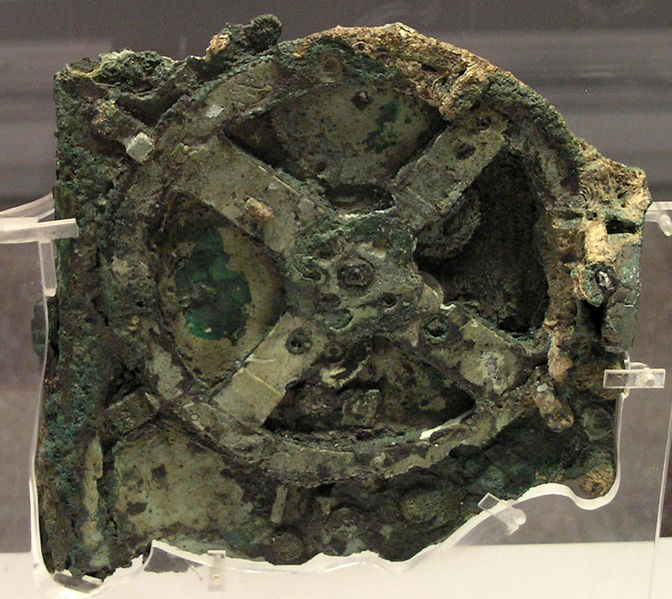
The Antikythera mechanism is an Ancient Greek astronomical simulation device. It sank in the early 1st century BC along with the ship it was travelling on near the island that's given the find its name, and was fished out of the Mediterranean a century ago. A paper in today's issue of Nature presents new work with computer-aided X-ray tomography which has allowed a team of scholars to understand better how the thing worked and to decipher more of its many inscriptions. Using a large number of cogged wheels and gears, the mechanism was designed to simulate and predict the movements and interrelationships of the more important heavenly bodies. Most likely, such contraptions were built among the followers of Hipparchus and Posidonius, whose known interests and level of astronomical insight fit well with the mechanism.

The funny thing about the Antikythera mechanism is that it appears to be isolated, popping up more than 1000 years before the documented start of the High Medieval clockwork tradition. This impression may be due to our incomplete knowledge of what Arabic scholars were doing through the Dark Ages -- they certainly relayed a lot of other Ancient Greek work to posterity. But still, when Medieval Western Europe learned to make clockworks, the technology spread like wildfire, so rapidly that it is impossible to tell exactly where it started. Not so with Antikythera. We have a single find and a few brief mentions of similar tech in the literature of the time. Why is this?

I'd like to submit an idea. The reason that the Ancient Greek clockwork devices didn't catch on may have been that they weren't open source. A proprietary technology, guarded jealously among a small philosophical community, and useless to anyone lacking a solid astronomical education -- it would in fact have been highly surprising if it had started a wave of cultural diffusion. The specimen from the Antikythera wreck wouldn't have been travelling alone: it must have belonged to a philosopher bound for Rome, a man who could maintain the device and use it for astronomical demonstrations and predictions. To anyone else, the mechanism would just have been incomprehensible. And it lay in the best interests of its owner that the world at large remained in the dark about such arcana.

[More blog entries about , , , ; , , , .]

Labels: , , ,

Tuesday, November 28, 2006

Another Great Dane

As noted here before, I'm a big fan of Danish archaeology. They have cool material, good scholars, a solid scientific tradition and hardly any tiresome wannabe philosophers nibbling away at their archaeological university funding.

Esben Schlosser Mauritsen is one of the great Danes, and here is his web site. Esben is into archaeology as extreme sports: aerial photography and underwater excavations are his specialities. Check out his project gallery!

[More blog entries about , ; , .]

Labels: ,

Wednesday, November 15, 2006

Vietnamese Millennia


Yesterday my wife and kids let me loose for a few hours to go stare at old stuff. Being a responsible husband and father I really tried to find a four-wheel taxi or bus to improve my chances of survival for the trip. But I ended up on what the locals call a "Honda embrace", a moped taxi, weaving crazily through the throng on my way to the Historical museum. Yet I live.

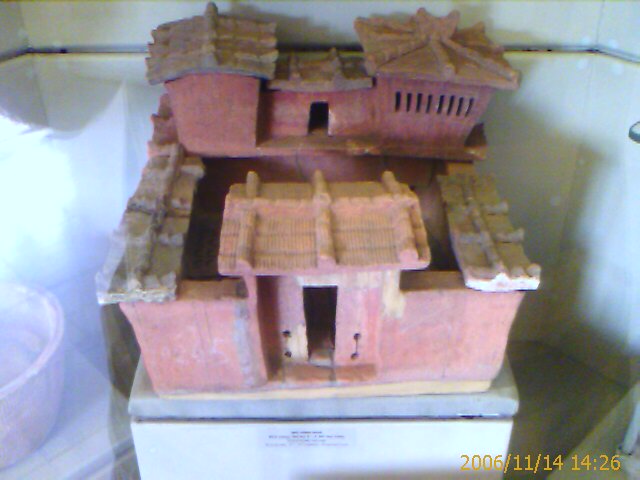
Hanoi's historical museum is a proud saffron architectural hybrid of the early 20th century, unashamedly colonial and in excellent repair. The displays cover palaeontology, archaeology and recent craftsmanship, from Homo Erectus teeth to mementoes of colonial period rebels. The exhibition philosophy is old-school apart from a few cave-dweller dioramas, with entire site inventories displayed down to the last cutmarked rhino vertebra. Good for me, boring for the casual visitor. But the cases are enlivened by panoramas of landscapes and excavations plus a lot of photographed excavation sections. The latest additions to the cases represent excavations only a few years ago.

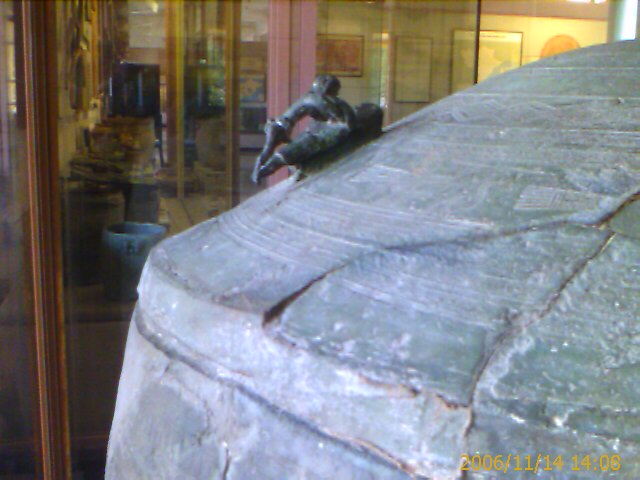
The Neolithic pottery is very nice, but things really pick up with the Bronze Age which is absurdly rich, this being south-east Asia. 170 bronzes in one log-coffin burial, you get the idea. A dozen Dong son culture drums offer wonderfully alien stylised imagery of birds, bird-men and warlike boat crews, the latter actually much like coeval rock carvings in southern Sweden. (Look for the miniature bonking taking place on the lid of a particularly huge bronze urn!) Then comes the Han dynasty Chinese cultural juggernaut and transforms everything. A selection of beautiful Champa sculpture is also offered, the melon-bosomed Hindu dancing girls you always see in Indian art portrayed here with unmistakeable Vietnamese faces and big grins.


The museum clearly caters primarily to the locals, as the many texts and maps are mostly in Vietnamese. Shorter but informative labels in English and French also abound. Confusingly, there is a consistent 2000 year discrepancy between the dates given in English and French respectively. As far as I can tell, correct French dates avant notre ère (BC) have been translated into English by someone who believes that notre ère means "today". A francophone visitor with some grasp of European chronology thus realises correctly that Northern Europe was pretty much a cultural backwater during Prehistory, while an Anglo gets the opposite impression.

[More blog entries about , ; , .]

Labels: ,

Saturday, November 11, 2006

Leifeng Pagoda


The last king of Wuyue during the Ten Kingdoms imperial interregnum was a devout Buddhist. One of his many religious construction projects was a towering pagoda on Leifeng, "Thunder Top", built to house a lock of Sakyamuni's hair. Completed in the AD 970s, the structure on the southern shore of the West Lake was refurbished and rebuilt repeatedly through the centuries until Japanese pirates torched it in the 18th century and it was abandoned. The tower's brick core still stood as a prominent landmark, sprouting small trees, a favourite haunt of tourists and lovers of romantic ruins, until it collapsed in the 1920s. Treasure hunters were most likely to blame for that final indignity.

The site still retained its fame, being associated with the story of Lady White Snake, and even Mao made an official visit to the ruin mound of the pious old king. Times changed, and in 1999 the burghers of Hangzhou decided to rebuild the pagoda as part of their investments in West Lake tourism. Archaeologists were called in to excavate, and the structure's various incarnations were identified all the way back to the 10th century crypt where the lock of hair had been housed. A considerable amount of fine votive metalwork was also unearthed, some of it having been antique already when deposited, indicating that the looters had good reason to target this particular site.

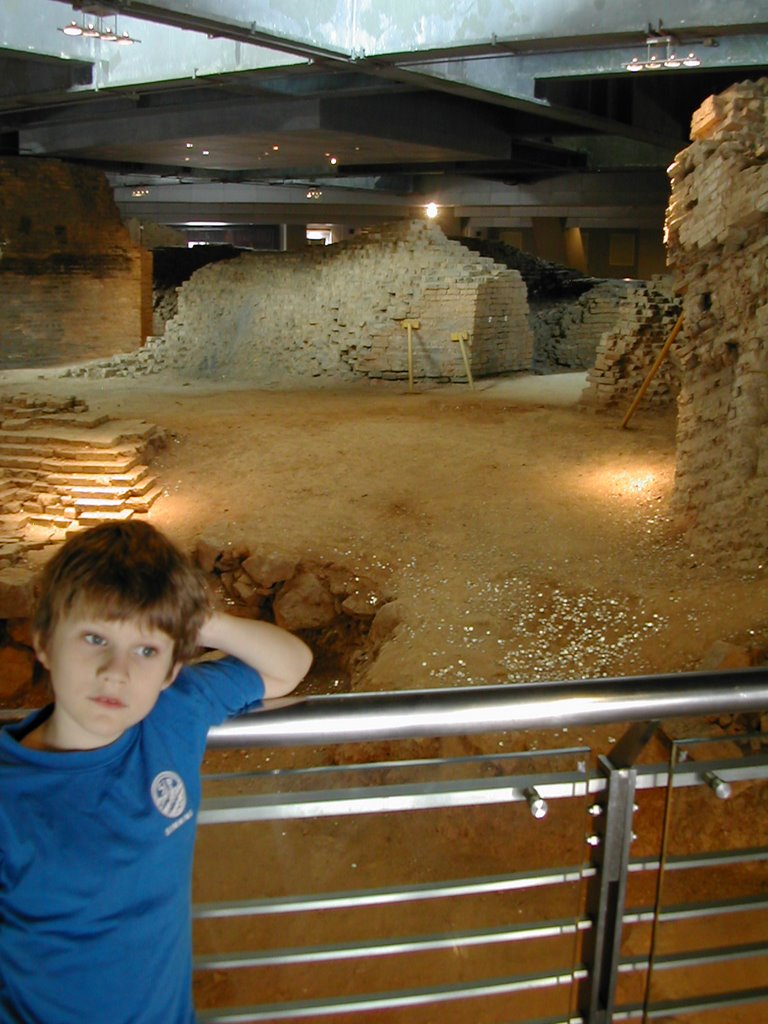
Until recently, Chinese reconstructions of ancient buildings have been pretty brutal, often obliterating the remains of the original structures. The philosophy seems to have been "we want to show the tourists something we can be proud of, not just crappy old ruins". The tourist-friendly parts of the Great Wall, where not a single original stone can be seen, are a case in point. But recently, a more respectful attitude has been adopted. In 2002 a magnificent new octagonal five-story pagoda was inaugurated on Thunder Top, yet again dominating the West Lake's southern skyline. But the new structure stands on steel stilts with the remains of its predecessors preserved and displayed in situ in the basement.


Visitors toss droves of coins onto the old brick walls. I wonder if many of them do so out of piety. Buddhist cult with incense-burning and praying is encouraged outside a building at the foot of the hill housing a silver reliquary found by the archaeologists. It's the first time I've seen an archaeological find becoming the object of religious worship, as opposed to religious relics housed above ground attracting the interest of archaeologists.

The new pagoda looks great from afar. Close-up, it's pretty tacky like all modern Chinese re-imaginations of the past, unabashedly made of modern materials, its faux-copper columns painted with metallic plastic. It's basically a fancy lookout tower for tourists with display cases full of neo-classical Chinese artwork. But each age has of course rebuilt the thing for its own purposes and with the materials available. One day the 2002 version of Leifeng pagoda will also be excavated by curious posterity.

Labels: , , ,

eXTReMe Tracker