Monday, November 20, 2006

Behind the Great Firewall

A week each in Hangzhou, China and Hanoi, Vietnam has taught me a bit about Far Eastern internet censorship and how to get around it. From Hangzhou, I have been entirely unable to access

This has been a major hassle for me as those sites are otherwise constantly revisited stations on my daily internet wanderings. To post entries to my blog from China, I've had to e-mail them, which has led to formatting problems and precluded pictures. In order to read blogs on Blogger.com, I have had to use

The more techno-literate may have use for Proxy4free.com as well.

A quick sampling turned up other blocked sites:

In Hanoi I didn't have this kind of problem at all. Despite the Vietnamese government being similar to the Chinese one (non-elected, anti-free-speech, nominally Communist, practically Capitalist), I could access the sites I wanted from our hosts' home computer. According to our hostess, Vietnamese internet censorship occurs somewhat haphazardly at the ISP level, which means that some bandwidth providers will let you do whatever you want.

This squares well with our impression that Hanoi, though a much grubbier and less affluent city, is far more aware of the West than skyscraper-studded Hangzhou, where non-salespeople in the street sometimes excitedly yell "Look at the foreigner! HELLO!" when they see me. It very likely has to do with Vietnamese history: a century of French colonial rule, friendly exchange with Soviet Russia, the American occupation, foreign aid in recent decades.

But there may be a scarier explanation. The broadband connection we used in Hanoi is registered to a person working as a consultant for the Swedish foreign aid agency, SIDA. It's entirely possible that this connection has had the censorship machinery selectively turned off. And replaced with a wiretap.

[More blog entries about , , , ; , , , .]

Labels: , , ,

Friday, November 17, 2006

Water Puppets


Writing this back in Hangzhou on Friday evening after a day's air travel, I still have a vivid memory of last night's entertainment. It was truly unusual.

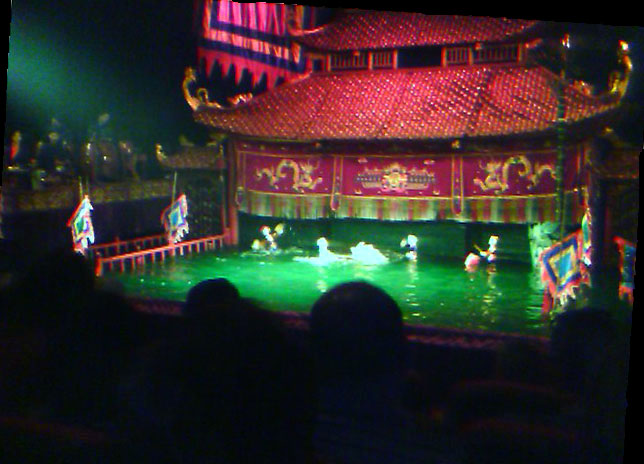
South-east Asia has a solid puppetry tradition with the Indonesian shadow puppets probably being the most well-known. To me, the Vietnamese water puppets were entirely new. This tradition is rooted in the rice-paddy landscape of the Red River delta where Hanoi and Haiphong are located. Performances would once be given during harvest feasting, celebrating the area's agriculture and fishing, its fauna and folkways. The players crouch in the dark behind a bamboo screen dividing a pool of water, extending garishly painted puppets on long poles under the screen into the well-lit part of the pool overlooked by the audience. Many puppets have movable parts manoeuvred with strings inside the poles.

We caught a performance at the Water Puppet Theatre overlooking Lake Returned Sword, where the same 45-minute show is given five times a day. The audience was almost entirely European in appearance. Stage right, an excellent musical octet in traditional garb played energetic classical Sino-Vietnamese music and acted as chorus. I love live music and was particularly impressed by the flutist and the soprano, one a jovial man of middle age, the other a young woman who looked like she was dying of boredom but who nevertheless sang like a goddess. Most of the speaking parts were performed by the eight invisible puppeteers behind the green screen, topped by a traditional Chinese-style temple.

There didn't seem to be any story to the evening's performance, which was probably wise given the audience's general lack of language comprehension. We were treated to a series of vignettes and skits, many humorous, some mainly demonstrations of the puppeteers' skill and coordination set to music. Dragons frolicked and fought, a swamp cat stole a farmer's duck and the Golden Turtle took the divine sword from the hand of Le Loi. Water sprayed and cascaded, we had fireworks, and the puppets were many and elaborate. Great show, even for a foreigner who knows neither the cultural background nor the language.

[More blog entries about , ; , .]

Labels: ,

Wednesday, November 15, 2006

Vietnamese Millennia


Yesterday my wife and kids let me loose for a few hours to go stare at old stuff. Being a responsible husband and father I really tried to find a four-wheel taxi or bus to improve my chances of survival for the trip. But I ended up on what the locals call a "Honda embrace", a moped taxi, weaving crazily through the throng on my way to the Historical museum. Yet I live.

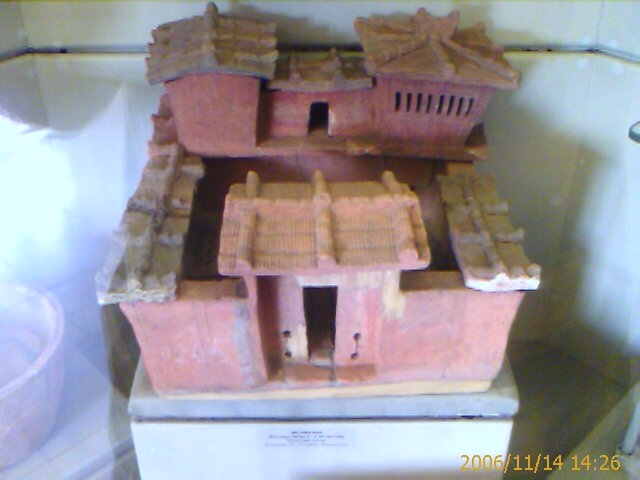
Hanoi's historical museum is a proud saffron architectural hybrid of the early 20th century, unashamedly colonial and in excellent repair. The displays cover palaeontology, archaeology and recent craftsmanship, from Homo Erectus teeth to mementoes of colonial period rebels. The exhibition philosophy is old-school apart from a few cave-dweller dioramas, with entire site inventories displayed down to the last cutmarked rhino vertebra. Good for me, boring for the casual visitor. But the cases are enlivened by panoramas of landscapes and excavations plus a lot of photographed excavation sections. The latest additions to the cases represent excavations only a few years ago.

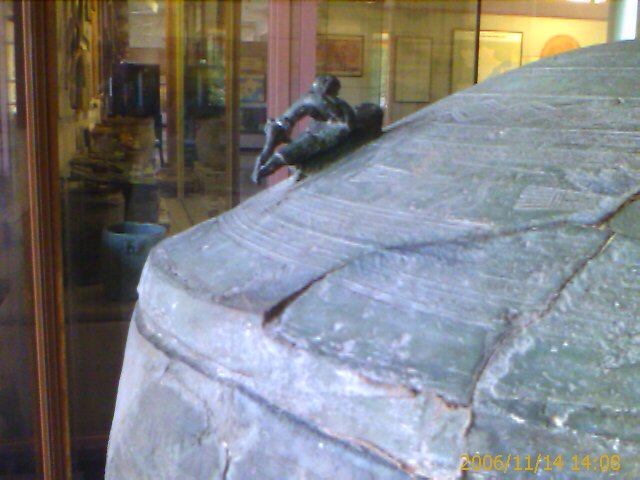
The Neolithic pottery is very nice, but things really pick up with the Bronze Age which is absurdly rich, this being south-east Asia. 170 bronzes in one log-coffin burial, you get the idea. A dozen Dong son culture drums offer wonderfully alien stylised imagery of birds, bird-men and warlike boat crews, the latter actually much like coeval rock carvings in southern Sweden. (Look for the miniature bonking taking place on the lid of a particularly huge bronze urn!) Then comes the Han dynasty Chinese cultural juggernaut and transforms everything. A selection of beautiful Champa sculpture is also offered, the melon-bosomed Hindu dancing girls you always see in Indian art portrayed here with unmistakeable Vietnamese faces and big grins.


The museum clearly caters primarily to the locals, as the many texts and maps are mostly in Vietnamese. Shorter but informative labels in English and French also abound. Confusingly, there is a consistent 2000 year discrepancy between the dates given in English and French respectively. As far as I can tell, correct French dates avant notre ère (BC) have been translated into English by someone who believes that notre ère means "today". A francophone visitor with some grasp of European chronology thus realises correctly that Northern Europe was pretty much a cultural backwater during Prehistory, while an Anglo gets the opposite impression.

[More blog entries about , ; , .]

Labels: ,

Tuesday, November 14, 2006

Old Hanoi


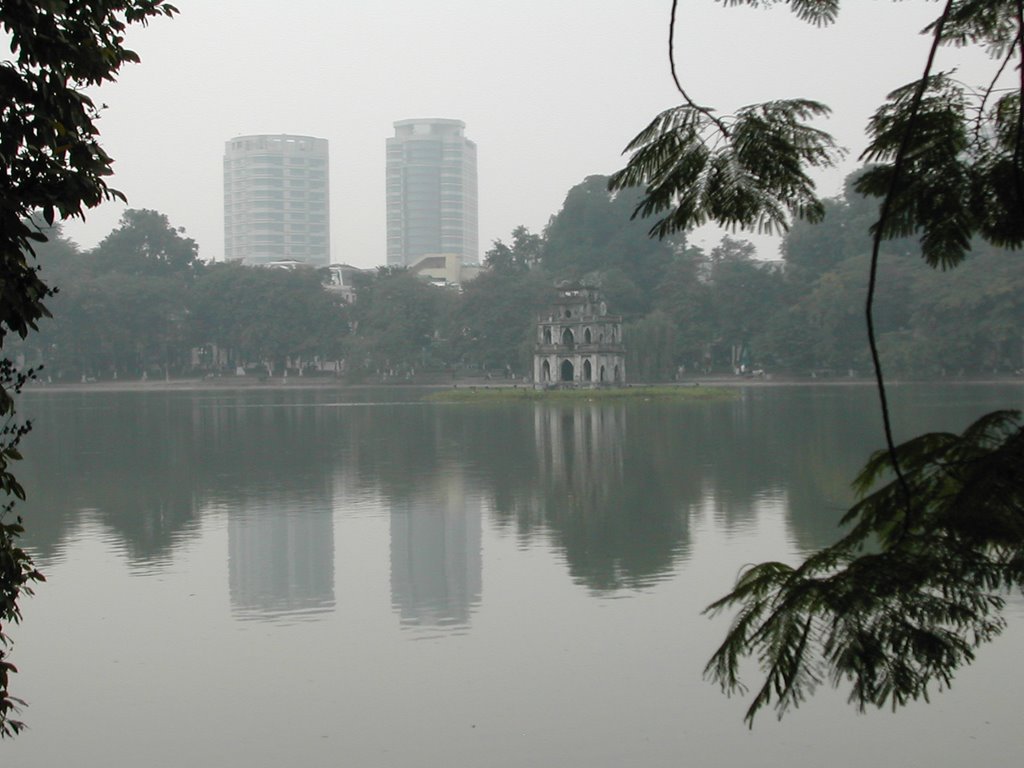
At the heart of modern Hanoi is a small lake named Hoan Kiem, "Returned Sword". This moniker goes back to a legend about the 15th century national hero Le Loi who led a successful rebellion against the Chinese. Fishing in the lake outside the town walls, young Le Loi caught a golden sword in his net. Very Arthurian. This weapon he wielded in battle for many years before returning one day as a king to thank the lake's spirit with an offering. The gods at this point apparently felt that he needed no more assistance, and so the king, eyes agog, saw the sword fly from its scabbard out over the lake and into the mouth of a golden turtle surfacing for the occasion. Mission accomplished, sword returned.

There is actually a dwindling stock of massive turtles in the green water. One was caught in 1968 and is on display in a small 19th century temple on an islet, just off the site of an obelisk with a trippy inscription in three Chinese characters: "Write Turquoise Sky", that is, take that bamboo brush and scribble away at the firmament. "And so I throw the windows wide and call to you across the sky".


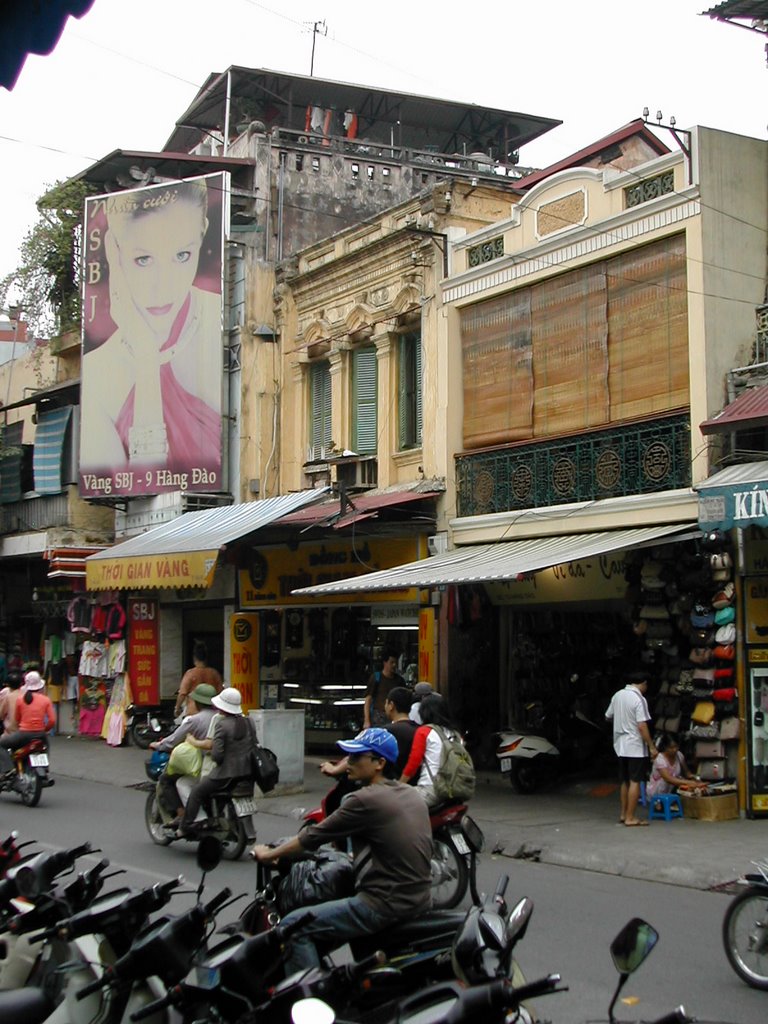
Hanoi's Old Quarter is just north of the lake, a moped-infested maze of narrow alleys lined by two- and three-story houses with storefronts at ground level. The typical building is called a Tube House, as it is very narrow and very long, wall to wall with its neighbours. Before electrical lighting, such a structure would have several open-air courts along its length to admit light and air. After lunch today we visited a renovated late-19th century example and got a feel for what they were like.


Like a Medieval European city, the Old Quarter was walled and its streets specialised by trade: Butcher Street, Baker Street etc. And as with most of its European equivalents, the Old Quarter's walls have been torn down and the streets' specialities mostly survive only as names. No longer does anyone expect to buy fish in York's Fishergate or cups and pots in its Coppergate ("gate" here being a Scandinavian loan word, cf. Sw. gata). But although many of the old specialities are gone, specialisation itself is still very much apparent in Hanoi: Oil Street merchants deal almost exclusively in shoes, Drum Skin Street has bags and upholstered furniture, Sugar Street has clothing. This can be frustrating for the tourist who wants a snack and can find nothing but ladies' fashion.


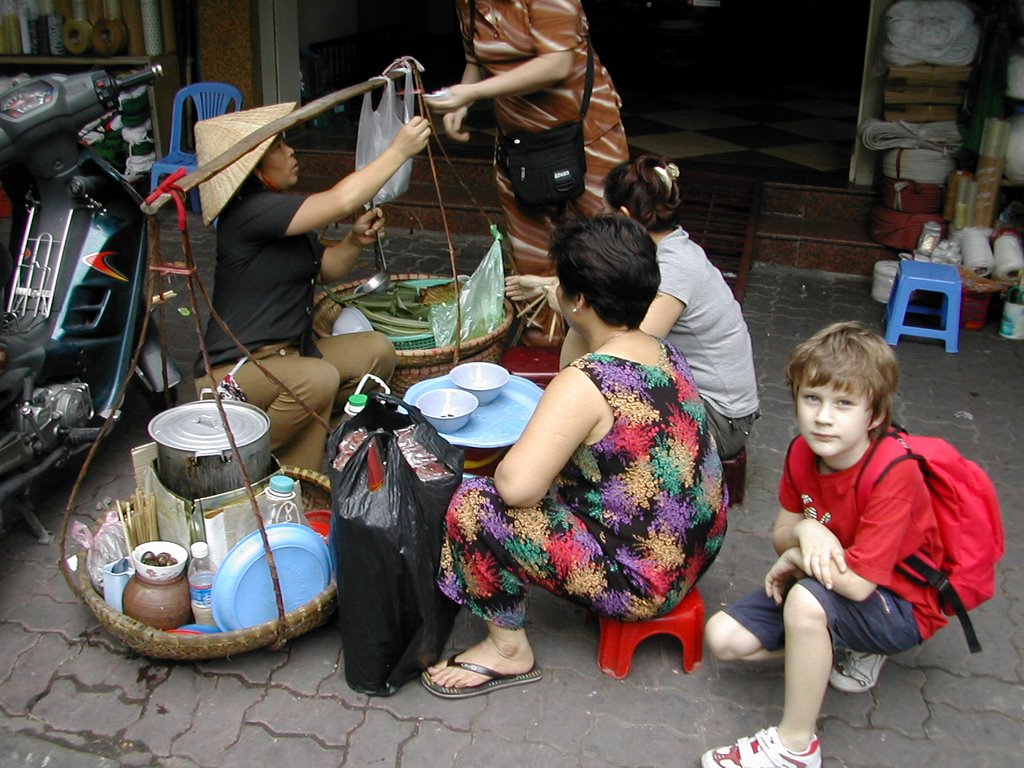
I like the food streets, just like I love to prowl covered markets in Europe. In addition to a lot of familiar stuff, Hanoi's small-time butchers and fishmongers offer some pretty wild goods. We saw tiny wiggly leeches sold by the cupful, maggots, live poultry, a little runaway crab making its last stand in the dirty street, but funnily no identifiable cuts of dog.

Dog is apparently holiday food, associated with certain phases of the moon, believed to cleanse your system and increase erectile stamina. I gather that erection problems are kind of an international ethnic trauma among Far Eastern men, with sad consequences for the tigers, rhinoceri and snakes that get made into, well, snake oil. Looking at the region's population growth figures, I can't really see why these guys worry. It's not like they have anything left to prove.

[More blog entries about ; .]

Labels:

Sunday, November 12, 2006

Mopeds and Ancestor Worship in Hanoi


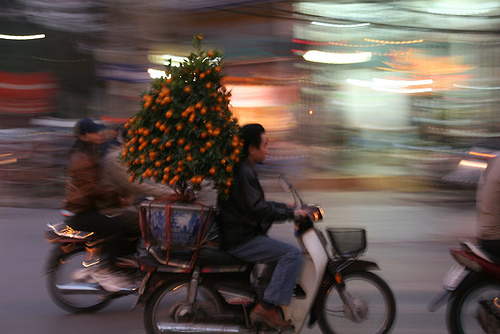
Arbre de Têt dans le trafic. Par Petit Dragon.

The streets of Hanoi aren't dimensioned for cars, and the public transportation system isn't dimensioned for the Vietnamese capital's current two-million population. So everyone drives a moped -- kamikaze style.

They're everywhere, they go fast, they sound like giant mutant wasps (hence the Italian Vespa) and there are rarely less than two people on each vehicle. Oh, and they beep. Our host, charming Swiss stay-at-home dad Patrick, took me for a ride this morning on his own steed, so I've been there and lived. (He's an ace photographer, check out his Vietnamese work.) We checked out the Ho Chi Minh mausoleum (the old man wanted to be cremated and popped into the earth on a hillside where people could go to plant trees, but such is of course not the fate of successful revolutionaries), one of the world's few surviving colossal Lenin statues, the elegant colonial architecture of the French quarter, the remains of a B52 bomber shot down about the year I was born and now proudly displayed, the works.


Our hostess is the enchanting Swedish blogger Zornkvinnan (alas, she currently doesn't often grace the intartubes with her writings) who has made friends with my wife. The two ladies met for the first time last night at the airport and seem to be getting along really well. We all had a typical Hanoi lunch at a rootsy sidewalk eatery where the mopeds whizzed past at arm's length. Barbecued minced-pork patties, noodles, fresh liquorish-tasting greens, all dunked in hot broth seasoned with chili, garlic and fish sauce. Heavenly! Then we walked through the drizzle from awning to awning in the Old Quarter's most cramped market alleys, looking at food and napping saleswomen, buying a miniature tea set for my daughter. It's intended for the ancestor cult at the ubiquitous house shrine, though I believe its new owner may be more likely to use it for entertaining her dolls. Let's hope that this entices a few friendly ex-mopedist's spirits to take up residence in our playroom, ensuring health and prosperity.

[More blog entries about ; .]

Labels:

eXTReMe Tracker