I grew up among science-friendly but non-skeptical people. My parents gladly paid my subscription to a pop-sci magazine. Vaccination and antibiotics were uncontroversial. But so were Gestalt therapy, herbal medicine, church service, youth choir, Bible study groups, evening prayer, Rosen Method therapy, acupressure, osteopathy, chiropractic and Hazelden self-help groups.
When I finished ninth grade in 1987 (thus graduating from mandatory school), the headmistress rewarded me for my grades with a copy of
Strange Stories, Amazing Facts, a weighty volume issued by Reader's Digest in 1976. I had already read the book from one end to another repeatedly in the school library, where it was about the first thing I had found. (I spent recess for much of six years in that library with my friends). And it actually reads a lot like the
Snopes urban legends site, but without the debunking. Ghost stories and scientific trivia mixed in one big salad: Strange Anecdotes and Amazing Unsupported Statements. My school not only offered such materials while I was a pupil, in effect it also encouraged me to continue reading them as an adult.
I don't remember anyone presenting me with a generally skeptical perspective or the basics of critical thinking at home nor at school. The truth of any statement was based upon social acceptance, and in 1980s middle-class Stockholm much, but far from all, of this accepted truth was based in science. Nobody seemed to care much about the foundations of truth. Challenging someone's beliefs was seen as rude and recalcitrant behaviour.
The first instance I recall of anyone actively questioning conventional wisdom was in high-school when my friend Tor told me about his dad's attitude to astrology. Aage is an astronomer, and he didn't just not believe much in astrology, he vehemently opposed it. This was a novel idea to someone who had grown up with Boomer parents always going off on "a course" or being "in therapy". Tor's parents, both research scientists, became role models for me. I borrowed their copy of Carl Sagan's pop-sci book
Cosmos (1980) and liked it a lot. I remember being amused by the bit towards the end where Sagan advocates pre-marital sex as a way of helping young people feel better about themselves and life in general. I agreed completely, having been lucky in that regard.
So I think it's fair to say that during high-school I developed a healthy skepticism. It was certainly part of me by the time I became an undergrad. But still, I did fall for some pretty bad woo-woo in my senior year.
My final term paper was about what was then called Planet X, the question whether there might be an undiscovered tenth planet beyond Pluto. This issue has since been resolved with the insight that Pluto is actually a member of a numerous class of small icy bodies way out there, forming the
Kuiper Belt, with no sign of anything even the size of Mercury orbiting beyond Neptune, let alone another gas giant. There is no tenth planet – there never even really was a ninth one.
Aage photocopied some papers on the Planet X issue and lent me books, of which Mark Littman's
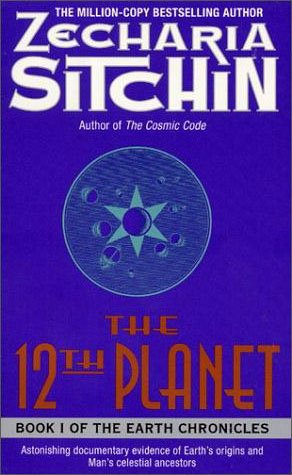
Planets Beyond (1988) was particularly good and afforded much material. But I had also found another book on my own in the local bookstore that I liked a lot and saw as highly relevant to the Planet X issue. Here's what 17-year-old me had to say about
Zecharia Sitchin's
The 12th Planet (1978):
"The first civilisation on Earth appeared very suddenly about 4000 BC in Mesopotamia, modern Iraq. This Sumerian culture was very advanced and created the basis for all human civilisation. In his book The 12th Planet, the Jewish American prehistorian Zecharia Sitchin poses the question how this happened, and points out a large number of anomalies in the extant historical record. His thesis is that humankind and civilisation were created by alien beings, and he supports his arguments with everything from linguistics to astronomy.
The astronomical aspect of Sumerian culture is particularly interesting – Sitchin quotes cuneiform tablets that indicate that the Sumerians had exceptionally advanced astronomy that can only be compared to what we have today. Not only did they have a heliocentric view of the universe and detailed knowledge about the stars all around Earth – they also appear to have had knowledge of all the planets known to us, plus yet another one! A Sumerian document says: 'All in all twelve members, counting the Sun and the Moon, form the orbits of the planets'.
The Sumerians saw this tenth planet as the abode of the gods, and considered it to orbit far beyond Pluto. Drawing upon Sumerian descriptions of the planet and its orbit, Sitchin suggests a planet in a sharply elliptic orbit with a mass several times that of the Earth and an orbital period of 3600 years – he also believes that it must have a highly active core leading to a high temperature in order for life (the alien visitors) to be able to survive so far from the Sun.
Generally, for a fairly notorious genre, Sitchin's book makes an unusually matter-of-fact impression – he does get a bit too enthusiastic sometimes, and then his insufficient knowledge of natural science is laid bare, but his arguments regarding the Sumerian sources are fairly sober. If Sitchin's interpretation of the Sumerian sources is correct, then we can look forward to another visit by the twelfth planet to the inner reaches of the solar system about AD 3600."
To be fair to my younger self, I should point out that I didn't mention Sitchin in the paper's conclusions, which are quite cautious and concentrate on the weird orbits of Neptune's moons. My main problem while writing the paper was clearly that I knew absolutely nothing about Mesopotamian archaeology and didn't check even a basic textbook on the subject. I did know a bit of science and was skeptical of Sitchin in that area, but I didn't extrapolate this skepticism into fields where I knew nothing. I was supervised by my physics teacher, an engineering school dropout who probably knew about as much as I did about ancient Mesopotamia. The task I had set myself was to read up on planetary astronomy, and I don't remember ever thinking that I might have to read any more archaeology. This is actually typical of a lot of interdisciplinary pseudoscience produced by far more mature people. But I got a good grade for the paper and no complaints from the teacher. Only one of the admittedly few readers was rude and recalcitrant enough to question my endorsement of Sitchin: Tor, the son of scientists.
[More blog entries about skepticism, astronomy, archaeology, zechariasitchin; skepticism, skepsis, arkeologi, astronomi, zechariasitchin.]Labels: archaeology, astronomy, skepticism
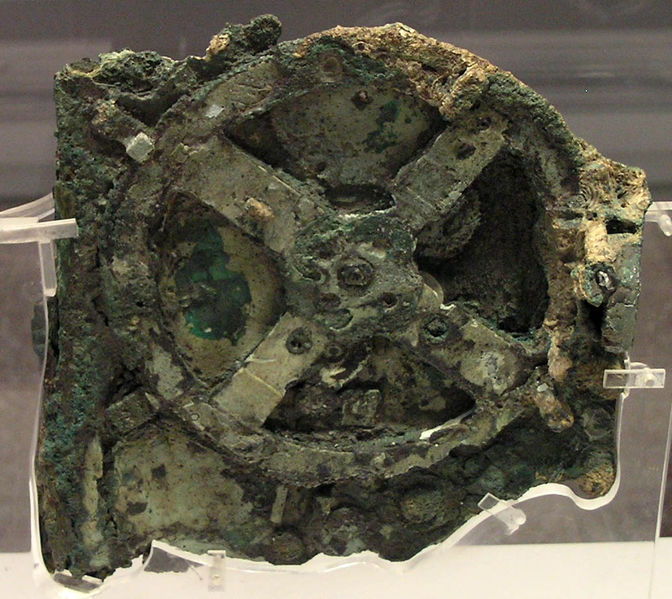
 Candy Minx picked up on something I wrote about the Antikythera mechanism. Here are a few comments to what she wrote.