Sunday, November 26, 2006

Yixing Tea Cups

My attempts to buy nice big tea cups in Hangzhou and Hanoi came to naught for two reasons.
  • Traditional Far Eastern tea cups are the size of egg cups.
  • Modern Far Eastern household goods are designed to a taste that screams CHEAP AND TACKY to the Western eye. (Yes, I know it's all relative and historically contingent.)
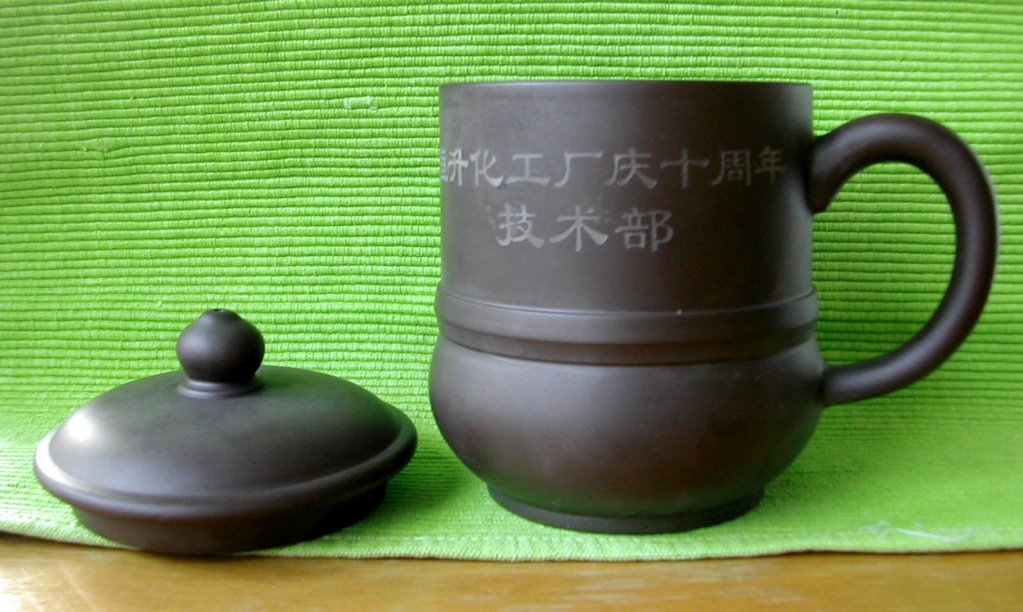
But still we did come home with good cups. My father-in-law took them from work and gave them to us. Apparently he's got a stash of them at the office.


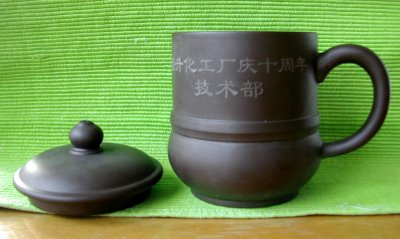
This zisha stoneware is really nice, unglazed, a matte dark chocolate, the vessel shape severe and elegant. The cups are made in Yixing in Jiangsu. I gather the clay is ancient, rich in iron, quarried from beneath formations of sedimentary rock.

Each cup carries an inscription. I fancied it a piece of poetry, perhaps something about cranes and harpistry and wind in the bamboo grove. I generally don't bother much about Chinese script: it's such a huge unknown to me that nibbling at the subject seems futile. But this was inscribed pottery, awakening my archaeological instincts. My wife read it for me.
Heng sheng hua gong chang qing shi zhou nien
Ji shu bu


Literally,
"Eternity rising transformation work factory celebration ten cycle year
Artisanship artisanship department".

That is,
"The Eternally Rising Chemical Factory, Tenth Anniversary
Technical Department".
So much for the poetry. Our beautiful new cups are in fact promotional items, high-end gifts for the employees of my father-in-law's dye factory on its tenth anniversary. But who will ever know? The inscription looks great regardless of its meaning.

[More blog entries about , ; , .]

Labels: ,

Monday, November 20, 2006

Behind the Great Firewall

A week each in Hangzhou, China and Hanoi, Vietnam has taught me a bit about Far Eastern internet censorship and how to get around it. From Hangzhou, I have been entirely unable to access

This has been a major hassle for me as those sites are otherwise constantly revisited stations on my daily internet wanderings. To post entries to my blog from China, I've had to e-mail them, which has led to formatting problems and precluded pictures. In order to read blogs on Blogger.com, I have had to use

The more techno-literate may have use for Proxy4free.com as well.

A quick sampling turned up other blocked sites:

In Hanoi I didn't have this kind of problem at all. Despite the Vietnamese government being similar to the Chinese one (non-elected, anti-free-speech, nominally Communist, practically Capitalist), I could access the sites I wanted from our hosts' home computer. According to our hostess, Vietnamese internet censorship occurs somewhat haphazardly at the ISP level, which means that some bandwidth providers will let you do whatever you want.

This squares well with our impression that Hanoi, though a much grubbier and less affluent city, is far more aware of the West than skyscraper-studded Hangzhou, where non-salespeople in the street sometimes excitedly yell "Look at the foreigner! HELLO!" when they see me. It very likely has to do with Vietnamese history: a century of French colonial rule, friendly exchange with Soviet Russia, the American occupation, foreign aid in recent decades.

But there may be a scarier explanation. The broadband connection we used in Hanoi is registered to a person working as a consultant for the Swedish foreign aid agency, SIDA. It's entirely possible that this connection has had the censorship machinery selectively turned off. And replaced with a wiretap.

[More blog entries about , , , ; , , , .]

Labels: , , ,

Sunday, November 19, 2006

Chinese Superstition


China has a millennia-old tradition of superstition (astrology, numerology, fengshui geomancy, qigong practicioners boasting supernatural gifts) and non-evidence-based medicine. Within a tradition of such medicine, there is a mechanism that weeds out treatments with any strong effect: damaging ones disappear because they lead to lawsuits against druggists and physicians; significantly beneficial ones disappear because they undergo clinical testing and become co-opted by scientific medicine. Chinese medical researchers, meanwhile, are doing well in their international scientific field and not paying much attention to the roots, fungi and snake blood of the trad quacks.

Traditional drugstores are still very much a part of Chinese culture, often referring in their architecture and packaging to a curious blend of the aeons-old tried-and-true and the cutting-edge scientific. I visited one in Hangzhou the other day that looked like a 19th century merchant's residence. The message of Chinese alternative medicine to customers is that it is venerable, brand new, semi-magical, clinical, natural and high-tech. In fact, it won't hurt you and it won't heal you.

Numerology in its simplest form (based on the similarities of words) states that eight is good and four is bad. Everybody wants a phone number with 88 in it, and nobody is allowed to begin at a new job on the 4th, 14th or 24th -- neither in the Gregorian nor the Chinese Farmer's calendar. At least they don't have a problem with 13.

The old religions are once again encouraged in China, and many temple compounds currently look like construction sites thanks to the munificence of noveaux-riches entrepreneurs freed from the shackles of state socialism. Effigies of Mao Zedong receive considerable religious attention along with Amithaba, Guanyin, Laozi, Confucius and the others. Chinese Buddhism is such a mess -- simple stupid idolatry, the original intellectual content irrecognisable.

One internationally known new religious movement, Falun gong, is not liked at all by the authorities. FG's version of things is that they are a peaceful meditative movement being persecuted by a nasty totalitarian regime. In my view it's actually a case of a nasty manipulative millennarian cult being persecuted by a nasty totalitarian regime. FG's leader is one of the aforementioned qigong practicioners boasting supernatural gifts.

The latest piece of Chinese superstition I've come across is another combination of the rootsy and the pseudo-scientific. Stores offer little wooden cages neatly packed with short charred-black bamboo sticks. They're supposed to work as air-fresheners -- because of active carbon! If you ground several hundred sticks really finely, packed a filter with the powder and put it into an industrial-strength fan, then I guess it would actually work to free the air in a room of aerosols. But the little cages are at least an intriguing conversation piece until the next supernatural fad appears.

[More blog entries about , , ; , , .]

Labels: , ,

Saturday, November 11, 2006

Leifeng Pagoda


The last king of Wuyue during the Ten Kingdoms imperial interregnum was a devout Buddhist. One of his many religious construction projects was a towering pagoda on Leifeng, "Thunder Top", built to house a lock of Sakyamuni's hair. Completed in the AD 970s, the structure on the southern shore of the West Lake was refurbished and rebuilt repeatedly through the centuries until Japanese pirates torched it in the 18th century and it was abandoned. The tower's brick core still stood as a prominent landmark, sprouting small trees, a favourite haunt of tourists and lovers of romantic ruins, until it collapsed in the 1920s. Treasure hunters were most likely to blame for that final indignity.

The site still retained its fame, being associated with the story of Lady White Snake, and even Mao made an official visit to the ruin mound of the pious old king. Times changed, and in 1999 the burghers of Hangzhou decided to rebuild the pagoda as part of their investments in West Lake tourism. Archaeologists were called in to excavate, and the structure's various incarnations were identified all the way back to the 10th century crypt where the lock of hair had been housed. A considerable amount of fine votive metalwork was also unearthed, some of it having been antique already when deposited, indicating that the looters had good reason to target this particular site.

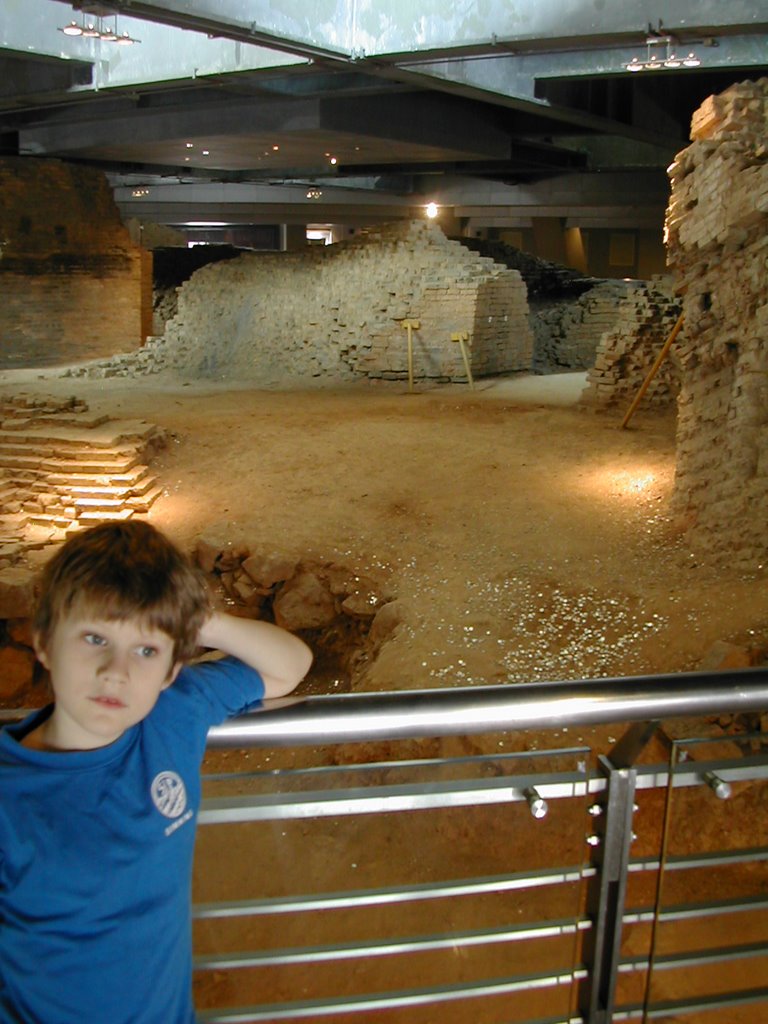
Until recently, Chinese reconstructions of ancient buildings have been pretty brutal, often obliterating the remains of the original structures. The philosophy seems to have been "we want to show the tourists something we can be proud of, not just crappy old ruins". The tourist-friendly parts of the Great Wall, where not a single original stone can be seen, are a case in point. But recently, a more respectful attitude has been adopted. In 2002 a magnificent new octagonal five-story pagoda was inaugurated on Thunder Top, yet again dominating the West Lake's southern skyline. But the new structure stands on steel stilts with the remains of its predecessors preserved and displayed in situ in the basement.


Visitors toss droves of coins onto the old brick walls. I wonder if many of them do so out of piety. Buddhist cult with incense-burning and praying is encouraged outside a building at the foot of the hill housing a silver reliquary found by the archaeologists. It's the first time I've seen an archaeological find becoming the object of religious worship, as opposed to religious relics housed above ground attracting the interest of archaeologists.

The new pagoda looks great from afar. Close-up, it's pretty tacky like all modern Chinese re-imaginations of the past, unabashedly made of modern materials, its faux-copper columns painted with metallic plastic. It's basically a fancy lookout tower for tourists with display cases full of neo-classical Chinese artwork. But each age has of course rebuilt the thing for its own purposes and with the materials available. One day the 2002 version of Leifeng pagoda will also be excavated by curious posterity.

Labels: , , ,

Friday, November 10, 2006

Green Tea at Longjing


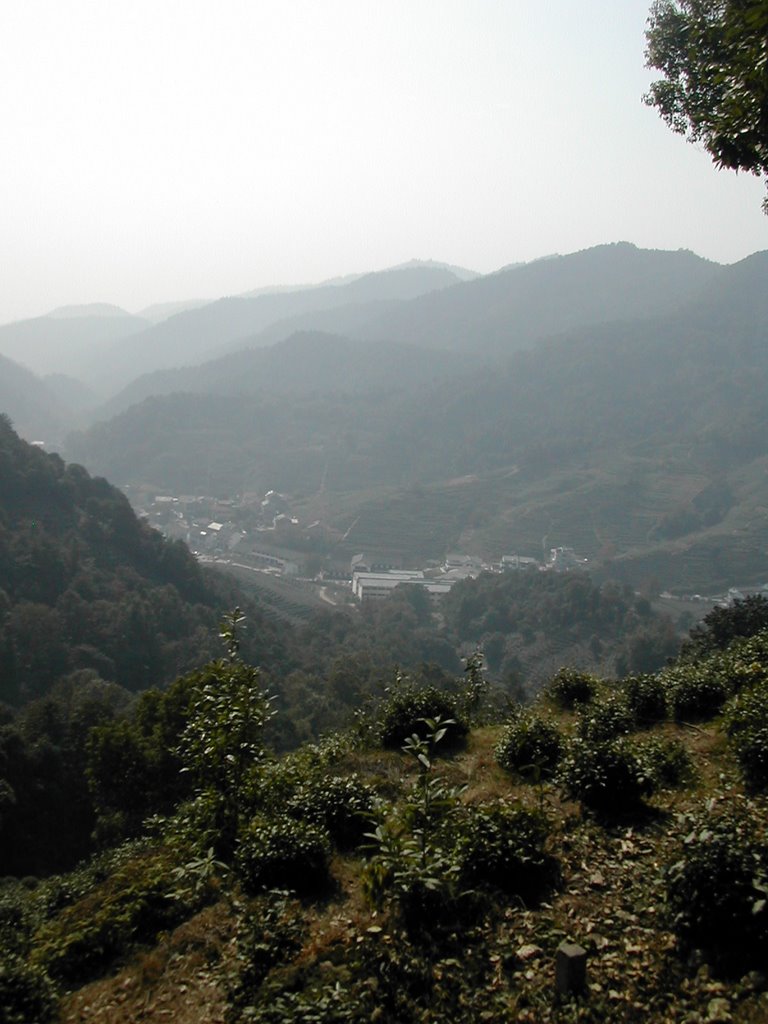
Old Hangzhou sits on the eastern shore of much-bepoemed West Lake and has recently exploded in a blast of skyscrapers and factories to the north, east and south. But west and south of the lake are still wooded hills, fertile parts of whose slopes are terraced and planted with tea. Yesterday we took a bus to Longjing, the village of Dragon's Well, which sits at the head of a valley surrounded by teabearing mountains. There are excellent hiking trails in the area, and we took the kids up along one of them to the top of Qipanshan, Chessboard Mountain. Actually, we didn't have to take them there, they happily ran up much of the path among bamboo and banana plants. None of the trees were more than a few decades old, so the area must pretty much have been denuded in recent times. There's a pottery industry near where we're staying with Medieval traditions at least since the South Song, so I imagine that logging pressure for the kilns must have been intense. (They used to make ceremonial porcelain for the Imperial court. Now they make toilets. Guess what ordinary people have more use for.)


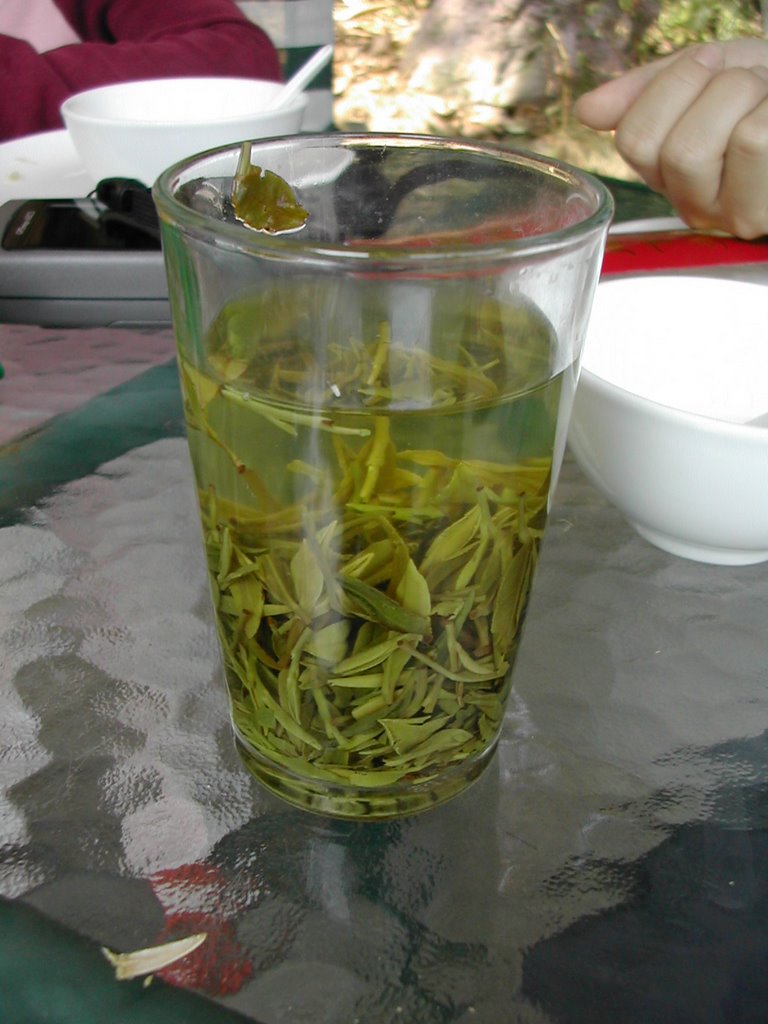
After our escalade, 750 horizontal meters either way as the crow flies, we had lunch under a parasol, listening to the squall of the fish tank and the maniacal keening of amorous insects in the trees. This being Longjing, which is a household name for tea in the Chinese-speaking world, we of course had some local green. And boy, did we get tea. There was hardly any room for water in my glass, its contents looking more like a salad than a beverage. I'm not much into green tea, it's just bitter-nutty water to me. But it was kind of nice to recognise the very same leaf buds that we had sampled off of blooming bushes on terraces up on the mountain. The food was nice: spinach with tofu, prawn and cured ham: red soy pork side with blubber on; and a thick-stemmed mustard-like plant chopped and fried with paprika and white slivers of, if I understood correctly, pig windpipe.


We spent the afternoon questing for pirated (or at least cheap) Gameboy games in the city, learning that for DS games it is no longer profitable to pirate them onto physical cartridges as the kids tend to mod their DS consoles and download games from the net. Just a more convenient medium, cutting out the middle man.

Labels: ,

Thursday, November 09, 2006

Jet Lagged Small Hours


Great to be reunited with wife & daughter! And the kids were really happy to see each other too. We left Hangzhou airport at three p.m. and went home to my in-laws, where I napped and then had dinner. Fried ribbon fish, soy beans in the pod boiled with salt, spinach with garlic, taro in pork broth, egg plant with soy sauce, rice. Did jigsaw puzzles with my daughter, put the kids to bed, retired for some quality time with my lovely wife at half past eight and soon fell asleep -- only to wake at little past three in the morning. So here I am, drinking tea, having a rou baozi (a wheat bun filled with ground pork) and a moon cake, reading Addison's vignettes about Roger de Coverley.

Outside there's a tremendous racket from trucks on the road and trains passing by, hooting like an orchestral brass section at each other. And on the other side of tracks are the homes of the poor at the feet of the wooded hills south of the West Lake. I hiked up there a few years back, discovering overgrown necropoli and a number of Buddhist shrines.
(Thursday 9 November 04:40).

Labels:

Changing Planes

I'm typing these words at Beijing International Airport, domestic gate 27. It's near lunch time here, four in the morning in my head. Not too badly zonked yet by sleep deprivation: the sunshine is bright and I accidentally bought a soda can of sweetened ice coffee with milk, branded Pokka. Couldn't read anything on the can, wanted to try some local stuff. The can was massive, almost twice the metal weight of a Western one.

Beijing smells of coal smoke and is wrapped in a faint ochre haze. Approaching for landing, we flew over something that looked a lot like a nuclear power plant with the characteristic truncated-cone cooling towers, surrounded by industrial sprawl and endless tenement housing blocks. And yet, as always in this country, there's small-scale agriculture on every spare scrap of land all the way up to the airport fence. The barbed wire festoons along its top are most likely there to keep guerilla subsistence farmers from planting qing cai along the runways. Urban zoning seems absent or at least negotiable.

My El Cheapo cell phone operator (dJuice) doesn't seem to have a roaming agreement with the locals, and not only is the wifi here blocked by a pay screen -- it's entirely in Chinese. So I can't get this on-line right away. Signing off at Wednesday lunch, 11:35 (GMT+8).

Labels:

Sunday, September 24, 2006

Righteous Noodles


We eat a lot of ramen / instant noodles (Sw. snabbnudlar, "quick noodles") at my place. I used to do it all wrong. For two fieldwork seasons I had ramen for lunch twice a week -- just the contents of the package with water added. How bland, how meagre, how boring! A package of ramen is like a package of spaghetti. It's the base of a meal, not a building kit with everything included.

My wife saved me from bland ramen by letting me in on some ancient Chinese lore. To enjoy the noodles, you need an egg (crack it into the boiling pot, stir it around) and some Chinese cabbage (try kimchi), sesame oil, and don't use all the powdered soup stock in the satchet. That makes for a good and filling meal.

By the way: eating Chinese cabbage raw (as it is served in Swedish school lunch rooms) is like eating potatoes raw. Wrong, wrong, wrong.

Soup stock satchets keep building up in our kitchen. I'm thinking of sending them anonymously to friends just to outweird them.

[More blog entries about , , ; , , .]

Labels: , ,

eXTReMe Tracker