Monday, December 25, 2006

Christmas Soft Drink Wars

The traditions and imagery of Anglo-American Christmas are largely Victorian and urban in origin: Dickens's Christmas Carol, C.C. Moore's Santa poem, eggnog, coal-fed fire places and chimneys, etc. These motifs have spread around the world, but they encounter other Christmas traditions along the way, and some prove resistant.

Swedish Christmas carries strong connotations of rural pre-industrial life. Our Santa Claus is actually a mutated version of a protective sprite that used to be the farmer's little helper: tomtegubben, the "old man of the home plot". Our presents, julklappar, "Christmas doorknocks", are the descendants of prank presents tossed through the front door of the farmhouse after a quick knock. We decorate our houses with billygoats and other ornaments made of straw. Our traditional Christmas food is almost entirely based on lo-tech methods of food preservation, with salted, cured and smoked meats and fish. The only vegetables are such as store well (cabbage, apples), or, in the case of kale, grönkål, can be picked all through the winter in the garden as it stands tall over the snow.

The other day, as I was shopping for Christmas food, I found evidence that Swedish Christmas traditions have actually managed to beat the Coca Cola Company.

In Sweden a soft drink is sold at Christmas and Easter that is perceived as a traditional part of the old-time rural Christmas complex. Julmust is dark, very sweet, carbonated, seasoned with malt and a tiny bit of hops -- not enough to give it the bitter edge of beer. It's sort of a caricatured stout for kids. And for years, Coca Cola has tried to muscle in on this seasonal soft-drink market with it's flagship product, a beverage that is actually quite similar to julmust. But they haven't made much headway. Most Swedes perceive Coca Cola as quite incompatible with a traditional Christmas. CC is seen as part of post-war modernity and consumerist culture: it's the opposite of authenticity. Drinking Coke at Christmas would be a bit like erecting a model space shuttle rocket instead of a Christmas tree and playing electronic dance music while the presents are opened.

So what's a poor old soft-drink multinational supposed to do? If you can't beat them, join them.

Since at least 2004, Swedish supermarkets have offered large handsome bottles of Bjäremust brand julmust around Christmas. The label design screams AUTHENTIC, RURAL and OLD TIMEY. Bjäre is a rich agricultural district in Scania, southernmost Sweden, and unmistakeably Scandinavian simply through the name's orthography. And who, you may ask, offers this fine julmust to the authenticity-seeking Christmas celebrant? The Coca Cola Company.

I put the Bjäremust bottle back on the shelf and got some Spendrups, after checking that they hadn't put aspartame in it.

[More blog entries about , , ; , .]

Labels: , ,

Christmas Geocaching


Geocachers sometimes put huge effort into temporary caches that are available only for a few weeks and then removed. The first one I encountered was a lovingly elaborated Easter Egg cache at Velamsund not far from where I live, which myself and the ladies of my family logged one sunny day last spring. Some of these super-rich caches even form annual series, such as the Trollvinter caches west of Stockholm.

Two of Sweden's most active geocachers call themselves Moomin and Snork Maiden after Tove Jansson's wonderful fantasy books. Hide a cache in some far-off location, protect it with a complicated puzzle involving differential calculus, and you can still count on Moomin finding it within hours. The man always keeps climbing equipment, an inflatable boat and other useful gear in the back of his car.

"Trollvinter" is a short story in Jansson's 1962 collection Det osynliga barnet (Eng. Tales from Moominvalley). Here the Moomins wake up from hibernation in the middle of winter and find all their neighbours in a tizzy over the approach of Christmas. The Moomins, never having heard of this before, interpret "Christmas" as a threatening being that is on its way to the Moomin Valley and must be appeased with offerings of food and presents.

The Trollvinter caches are far more peaceful in tone. Moomin and Snork Maiden select a small spruce tree in the middle of the Lovö woods, decorate it lavishly, adorn it with electric candles and wire it up to a car battery with an ingenious switch. Then they put a plastic crate full of little presents under the tree.

In order to find this year's Trollvinter cache me and my pal Lars had to wander through the woods, passing a series of tests on Moomin lore. Every station is marked with a little electrical lamp controlled by a photosensor. When you lift the final lamp from its stand to read the question underneath, you trigger the Christmas tree's candles. A beautiful surprise after dark!

Dear Reader, I wish you a merry yet supremely peaceful Christmas. Luckily, that's what I'm having myself. And meanwhile, I'm stockpiling longer blog entries for the new site, which I hope to have on-line some time within two weeks from now.

[More blog entries about , , ; , .]

Labels: , ,

Saturday, December 23, 2006

Overheard in Stockholm

Sweden's version of Overheard in New York is found at Tjuvlyssnat.se. The other day they had a tidbit that I really like.
(A subway train stops at the Östermalmstorg platform and the doors open.)

Driver: "... and watch out if you enter carriage number one. The floor may be slippery. It will probably also smell of fish, because someone's sat down and cleaned a salmon."
[More blog entries about , ; .]

Labels: ,

Friday, December 22, 2006

Radiocarbon for Christmas

Back in September I told you about a little dig that I did with my friends and colleagues Howard, Libby and Peter at Stora Tollstad, Sjögestad parish, Östergötland. We dug a small peripheral trial trench into a great barrow (Raä 16) and found a thick charcoal layer underneath it.
Yesterday Tomasz Goslar of the Poznan Radiocarbon Lab sent me the results of analyses of charcoal from the barrow. Ulf Strucke had kindly identified two pieces for me with a low innate age: one of Norway Spruce (Picea abies, Sw. gran) and one of Goat Willow (Salix caprea, Sw. sälg). The willow material, being a thin twig, should date the cremation pyre at the site (although we found no bones at its periphery). And the analyses came out beautifully!
Spruce. Poz-18592. 1265±30 BP. 685-775 cal AD (1 s).
Willow. Poz-18593. 1210±30 BP. 775-875 cal AD (1 s).


The Sjögestad barrow was clearly erected in the late 8th or the 9th century AD, that is, the Late Vendel or Early Viking Period. This fits well with the dates of similar barrows in the Lake Mälaren area and rules out a Bronze Age date, the other big barrow period in Swedish prehistory. And behind every great barrow lurks a powerful group of mourners...

[More blog entries about , , ; , , .]

Labels: , ,

Monday, December 18, 2006

High Medieval Farmstead


Iron wire brooch from Sommaränge, 14th century AD. Diam 27 mm.

The other day I received a copy of a new excavation report, produced by a number of close friends and dear colleagues at the SAU excavation unit in Uppsala. Three years ago, Emelie Schmidt Wikborg headed the excavation of a High Medieval farmstead at Sommaränge in Viksta parish, Uppland. I visited the dig once together with Emelie's hubby, my friend Jonas Wikborg, and I've followed the post-ex work, so it's great to see what came of it.

The building remains were pretty woolly due to the rural Medieval habit of erecting houses on wooden frames supported on easily removed stones instead of the age-old way with postholes. But there had been at least five houses including a smithy, and in addition there was a still-functioning well and the remains of a simple brick kiln. The site produced unusually many finds, including a surprising amount of metalwork with an aristocratic flavour: weaponry, spurs, dress ornaments, furniture mounts, combs and lots of horseshoes. This was at least partly thanks to the wise use of metal detectors before and after de-turfing. Check out the finds drawings by the great Stefan Kayat, who illustrated my doctoral thesis! The people who lived here were clearly a cut above the standard Medieval peasant.

The reasons that I like Sommaränge particularly are a) the number and quality of the small finds, which are always close to my heart, and b) the fact that the farmstead can pretty confidently be identified with a place mentioned from 1323 to 1482 in the written sources. It subsequently disappeared from the records: Giplinghe farm, or as it would be written in modern Swedish, Gipplinge. The excavation area was on the border of two villages that have historically fought over the land, probably because the marginal Gipplinge's demise did not take place in such a way that the rights to its land were entirely clear afterwards.

The dig also covered graves from the Bronze Age and Migration Period along with Late Neolithic and Bronze Age settlement remains, including a number of impressive burnt-stone mounds and rare Early Bronze Age metalwork. These prehistoric remains are treated in a separate report by Camilla Forsman and Helena Victor that hasn't appeared yet.

Emelie's a resourceful person. She keeps moving in and out of field archaeology and thus never seems to be unemployed: for a while she worked in the telecoms industry, then back to the trenches, and now she's with the state property management service. She's also an ex-punk chick and a rural culture geek who knows how to sing the cows home, milk them and make cheese. No wonder Jonas grabbed hold of her on her first dig and hasn't let go since.

The report isn't on-line here yet, but if you're into the real Middle Ages beyond the tournaments and castles and banquets, then you should get hold of a copy. Good stuff that you don't see every day.


Schmidt Wikborg, Emelie. 2006. Från gård och grund uppå Sommaränge Skog. Medeltida bebyggelselämningar i Viksta socken, Uppland. SAU Skrifter 15. Uppsala. 224 pp. ISBN 91-975994-4-1.

[More blog entries about , , ; , .]

Labels: , , ,

Thursday, December 14, 2006

Mats Widgren, Blogger

Professor Mats Widgren is a human geographer and a really nice guy. (I'm not just saying that because as a member of the Academy of Letters he's actually sort of my employer.) We're neighbours in Fisksätra and sometimes we chat on the train to town. I just found out that Mats has a blog. He's into prehistoric and early historic human geography, and so is actually an archaeologist in disguise. So there's a lot of archaeological interest at his site.

I was particularly interested in his view of Jan Henric Fallgren's and Maria Petersson's radical opinions about a late date for the Stone Wall fossil landscapes of south-eastern Scandinavia. They're usually viewed as active during the Late Roman and Migration Periods (c. AD 150-550), and that's the date that Mats prefers. He hasn’t been blogging very frequently, but if you give Mats some comments maybe he’ll take the hint.

[More blog entries about , ; .]

Labels: ,

Land of Four Thousand Archaeologists

My good friend and mentor Jan Peder Lamm has a thing for bibliographies. Specifically, he’s been the driving force behind a series of volumes listing photocopied BA and MA theses written by Swedish students of archaeology and adjoining disciplines. Many of these works contain very respectable research, with useful databases and thoughtful analyses. Thanks to Jan Peder’s efforts (and those of his disciples, including myself), they are far more accessible than they would have been if they had just been lying around the department store rooms.

It struck me the other day that these bibliographies allow one to estimate how many archaeologists Sweden has produced since the 1940s, assuming a BA or MA in the subject as a prerequisite for the moniker. I’m interested in this because of my strong opinions on the high unemployment rate in the profession. This is to my mind a result of a university system that strives to maximize student throughput and teacher employment rates without any view to whether the kids learn anything that might help them have a subsequent career.

There are sources of error: some theses may have been missed, and some people are listed both for their BA and their MA theses. But we should be able to see the order of magnitude. Let’s just look at theses in Scandinavian archaeology, which are the ones written by people who hope to work as archaeologists in Sweden.

For the period 1950-2003, the bibliographies list 4371 theses. They document decades of slow growth, and then a dramatic peak in the 1990s, when on average 87 theses where written each year only about the Iron Age. There is then an encouraging slump for 2000-2003, with an annual average of 63 Iron Age theses. Nevertheless, there must be thousands of people with archaeology BAs or MAs in the country, most of whom are not yet past retirement age. And believe me, there are not thousands of archaeology jobs: there may be two or three hundred. So it seems that in recent years, Sweden has had an overproduction of archaeologists on a rough scale of 10:1. Though the application numbers to recent jobs are more like 90:1.

I say, let's put a few tens of archaeology teachers on the dole, thereby stopping the university system from providing hundreds of unexperienced kids each year with a career path leading to unemployment.

[More blog entries about , , , ; , , .]

Labels: , , ,

Tuesday, December 12, 2006

Gingerbread Cult of St Lucy

Tomorrow's the feast-day of St Lucy, and my son's school started off the celebrations a day early. So this afternoon, along with a lot of other parents, I had saffron buns and watched kids in Ku Klux Klan and Santa outfits form a long line and sing Christmas carols. One end of the line was mostly a few bars ahead of the other.

As a pretty recent tradition, the morning of 13 December is celebrated in Sweden with quite a bit of ceremony. It involves white-robed, predominantly young female carolers led by a candle-crowned girl, performing a specialised repertoire of songs in honour of St Lucy (Sw. Lucia) and St Stephen in addition to generic Christmas carols. Considerable amounts of candles, saffron buns, ginger biscuits, coffee and sometimes mulled wine are consumed in the process. It's a huge deal in kiddie schools and Kindergartens. Flabberghasted Nobel laureates are woken before dawn at their hotels and relentlessly be-carolled.

This very Catholic custom is uniquely Swedish, which may be slightly surprising given the fact that the country has been Protestant since the 16th century. But winter in Sweden is dark and cold, with the weather steadily getting worse through the long autumn months. We really need a Candle Maiden in deep December when we're still a week on the wrong side of the solstice.

Björn Fromén of the Stockholm Tolkien Society translated a combination of the two most common Lucia hymns beautifully into High Elvish (and I just can't believe it's almost ten years since we put it on-line!). Here's the first verse:
Lumna cormóres nar
peler ar mardor,
or ambar alanar
caitar i mordor,
íre mir lóna már
ninquitar lícumar:
Ela i calmacolinde,
Lícumafinde!
And in Swedish:
Natten går tunga fjät
runt gård och stuva.
Kring jord som soln förlät
skuggorna ruva.
Då i vårt mörka hus
stiger med tända ljus
Sankta Lucia.
Sankta Lucia!
The tune is a traditional Neapolitan one, and the original Italian lyrics, coincidentally, are decidedly Tolkienian: Sul mare luccica l'astro d'argento..., "The silver star gleams over the sea...".


[More blog entries about , ; , .]

Labels: ,

Tuesday, December 05, 2006

Swedish Archaeology Mailing List

For over seven years, my pal Göran Werthwein has run a mailing list about archaeology in Swedish. More than 350 interested and knowledgeable people are on it. To join, click on the link and follow the instructions.

[More blog entries about , ; .]

Labels: ,

Sunday, December 03, 2006

Pseudoarchaeology Talk in Stockholm on Thursday

If you're in Stockholm and understand Swedish and are prepared to pay 50 kronor to hear a talk about the distinction between archaeology and pseudoarchaeology with illustrated examples of both -- then get thee to ABF, Sveavägen 41, on Thursday evening 7 December, 18:30. I'm the one doing the talking and I like Q&A.

[More blog entries about , , ; , .]

Labels: , ,

Archaeology Offers No Career

The Grumpy Old Bookman is fond of saying that fiction-writing is an excellent hobby but completely unrealistic, indeed self-destructive, as a professional career. I periodically repeat the same statement for archaeology. Scandinavia is one of the parts of the world where there are the most jobs per capita in archaeology. Still there are tens of unemployed Scandinavian archaeologists for each one that has a job, however short-term and badly paid.

Here's a recent newspaper story that shows what I'm talking about. Johanna Edqvist of Gothenburg has two MA degrees, one in archaeology and one in museology, and a €32 100 study debt. The only steady job she's been able to find is 25% of full time -- at a Kindergarten.

[More blog entries about , , ; , , .]

Labels: , ,

Sunday, October 29, 2006

Swedish Psychedelic Rock


Believe it or not, Dear Reader, but Sweden has produced a number of great psychedelic rock records. I'm going to tell you about three of my favourites, all of them with lyrics in Swedish, although the music is Anglo-American in style. But first some background.

The word "psychedelic" originally had nothing to do with music. It's a 1950s neologism meaning "mind manifesting". When hallucinogenic drugs began to become common, there was a debate among American psychiatrists about terminology. Should the drugs be seen as psychotomimetic, that is, do they mimic or cause (temporary) psychosis? This was the wary position. Or should they be seen as unlocking and manifesting a hidden positive potential in the human brain? This was the enthusiastic position, taken by people like Timothy Leary. Medical literature currently simply uses the word "hallucinogenic", since it's an accurate description of the substances' effect without entailing any hypotheses about the neurochemical nature of psychosis. And stoners say "psychedelic", particularly stoner musicians and their fans -- like me.

Psychedelic music was born in the 60s when rock and pop musicians discovered LSD and expressed their experiences with the drug through music. Albums commonly cited as the first examples of psych music are the Beatles' Revolver and the 13th Floor Elevators' Psychedelic Sounds, both released in 1966. One defining characteristic of the style is of course hallucinatory lyrics. But musically, it is largely a matter of the era's rapidly improving sound technology being used to produce weird otherworldly sounds, portraying the sensations produced by LSD. The Beatles' first psych song, "Rain" is heavily processed on all channels, some vocals even running backwards. "Tomorrow Never Knows" is a pounding, gibbering nightmare of tape loops. It would be very hard to produce convincing psych music using only acoustic instruments. It's music fulfilling Rimbaud's 1871 dictum that the poet should proceed through "long, immense and rational derangement of all the senses". Good psychedelic music can't be made while the musician is tripping, it takes a calculating artistic mind. Rational derangement.

So psych was born as pop. But a heavier streak was apparent already with the 13th Floor Elevators. Guitarists in the blues tradition quickly picked up the influences, along with new guitar effect pedals and amp feedback (which had first been committed to vinyl by the Beatles). Thus Jimi Hendrix, the great innovator of psychedelic rock, could make completely insane sounds live in a way that the studio-dwelling Beatles would never even attempt. His debut album Are You Experienced? from 1967 completed the sonic psych palette as we still know it. And people in Sweden were listening.

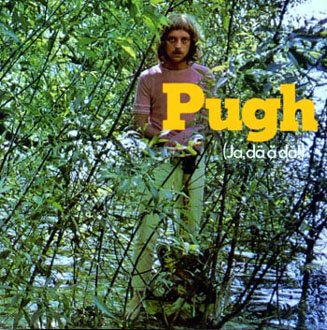
Our first great psych record is Pugh Rogefeldt's Ja, Dä Ä Dä from 1969. (The title means "Yes it is" in an exaggerated rural dialect, from one of the songs where Rogefeldt plays the part of a jilted lover who tells us through gritted teeth that he feels JUST FINE now that his girlfriend's left him. IT'S FINE. YES IT IS.) And Rogefeldt hadn't just learned the psychedelic lesson: he's funky as all hell too, with the great Georg Wadenius on bass and Janne Carlsson on drums, who had jammed with Hendrix and formed a duo with Bo Hansson. Dear Reader, Steal This Record.

Swedish 70s music unfortunately got bogged down in leftist political correctness and a misdirected concern with authenticity that made sure that ABBA (who were roundly denounced as commercial studio trash at the time) and a few punk acts were the only bands that came out of the decade sounding good. And the 80s were a psychedelic wasteland, no Paisley Underground here. But the 90s saw renewed interest in psych and progressive rock (no, Swedish readers, I'm not referring to Swedish progg). And so we reach another one of my favourite albums.

I'm very proud to say that I was down with Qoph before they even had a record deal. I heard them at a band competition in Stockholm a year or two before they released 1998's Kalejdoskopiska Aktiviteter, and they absolutely blew me away. The album's title means "Kaleidoscopic Activities", and they truly are. This is Hendrix territory with a lot of early 70s prog influences, particularly Captain Beyond whom Qoph outshine entirely. The blues roots are proudly exhibited, and though most of the material is way trippy and experimental, one song is a straight electric blues number. This album is a national treasure.

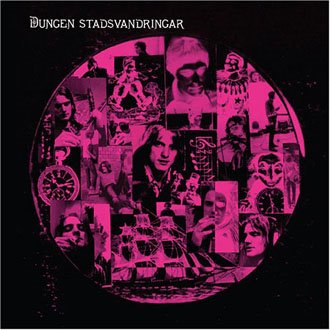
One of the redeeming qualities of the Swedish 70s obsession with musical authenticity was that the country's ethnic music (mainly fiddle-based) was rediscovered and reimagined by young people. There were good psychedelic takes on this stuff already at the time, notably by Kenny Håkansson and Kebnekaise who are still a great live act. But in my opinion, the best Swedish ethnic psych album is Dungen's Stadsvandringar from 2002 (it means "Strolls through the city"). And the band leader was born only in 1979, after the records that would come to influence him had been in the stores for years. But I don't need to tell you about Dungen, they were on Conan O'Brien a year ago. And they have a new album due next year.

So: Pugh Rogefeldt, funky Swedish psychedelic rock. Qoph, bluesy Swedish psychedelic rock. And Dungen, ethnic Swedish psychedelic rock. You know you need them to finally manifest your minds.

[More blog entries about , , , , ; , , , .]

Labels: , , , ,

Thursday, October 26, 2006

Fornvännen's Autumn Issue


The autumn issue of Fornvännen arrived a week or two ago, and I've somehow forgotten to write about it. As usual, it's full of exciting stuff.

Patrik Gustafsson and Mikael Nordin of the Södermanland County Museum in Nyköping report on survey work in Kolmården, a mountainous forest that formed an uninhabited boundary zone between the tribal territories of the Svear and Götar back in the 1st Millennium AD. Patrik and Mikael have located a number of Early Mesolithic shore-bound sites up there, dating from the 7th and 8th Millennia cal BC. Shore displacement in these parts has been dramatic.

Helmer Gustavson, John Hamilton and Laila Kitzler Åhfeldt of Stockholm report on the fragments of at least three Migration Period pictorial stelae found in later graves at Tomteboda on the outskirts of Stockholm. One of the stones has had a runic inscription, which is very rare at that early date, but unfortunately too few runes survive for them to be read. As part of the upheavals in the mid-6th century, people were clearly vandalising stone monuments erected only decades before.

David Damell and Martin Edlund in Örebro report on excavations at Råsvalslund in northern Västmanland. Far from any other known Viking Period settlements, they have found a large and affluent village with innovative construction techniques and well-equipped graves. David and Martin argue that the village's prosperity must have been founded upon iron production, which is well attested for the Viking Period in the area. They also found something really unusual: a bronze fishing lure!

There are a number of shorter items as well in this issue, but I'll just point out Henrik Thrane's opinion piece, which I really like. In the 1990s a funny tubular pottery object was found at a Bronze Age settlement near Norrköping. The excavators interpreted it as a damaged female figurine, something I couldn't really see at the time as they didn't offer even vaguely similar comparative material. But what do I know about the Bronze Age? Anyway, Thrane has now demolished their interpretation. As it turns out, the tubular thing is an ornate bellows nozzle used for bronze casting. It belongs to a common artefact class known from most of Continental Europe and discussed in the literature for over a century. It's just that this is the first time that it's identified among Swedish finds. And it took a senior Danish colleague to get it straight.

I think the poorly founded figurine idea was a typical result of overspecialisation: Swedish contract archaeologists are absolutely ace at fieldwork, but they rarely have any opportunity to learn about small finds. Nor are there any formalised channels for them to communicate with Sweden's few professional finds specialists. But I'm always glad to look at finds photographs. Keep 'em coming to my mailbox, folks!

[More blog entries about , ; .]

Labels: ,

Wednesday, October 25, 2006

They're Digging In Sigtuna


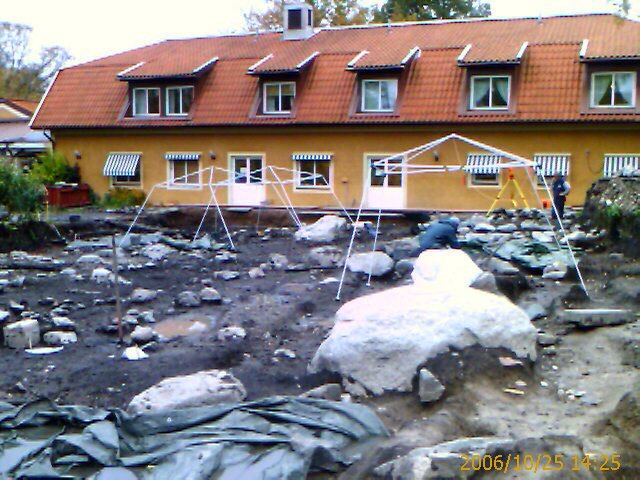
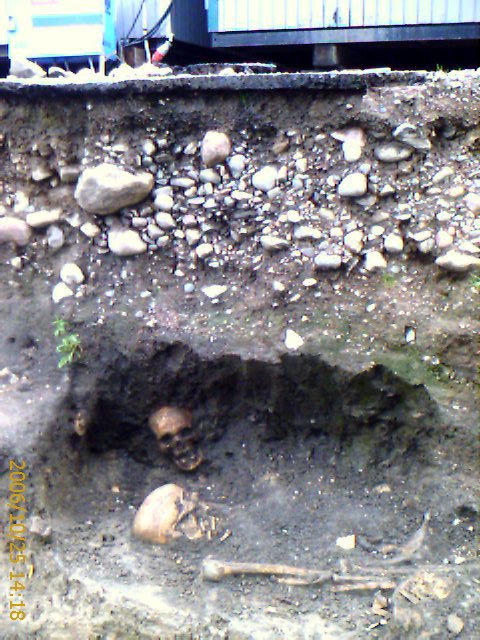
This afternoon I drove up to Sigtuna to check out the excavations there. A treatment centre for MS sufferers are building an extension to their premises, which has given my colleagues an opportunity to dig a big whopping trench a stone's throw from the town museum. Anders Wikström heads the dig and he's got quite a team, including a number of archaeology PhDs waiting for the Boomers to retire from the universities. They've been digging since late May, and yesterday they were all absolutely drenched by rain.


The town of Sigtuna was founded in the late 10th century as a successor to Birka. Unlike Birka, it was a Christian centre and soon received a great number of stone churches, one of which was the first brick building in the Lake Mälaren area. But Sigtuna's heyday was brief and power moved on to Uppsala and Stockholm. Since about AD 1200, the town has been a quiet little place. American tourists always find it entertaining that its name sounds like "sick tuna".


The site under excavation has been farmland since the Late Middle Ages, so the team came down into 11th century urban layers really quickly. The stratigraphy is only one to two meters deep with a lot of subsoil contour. Part of the trench holds the edge of a Medieval churchyard with over 200 burials excavated so far. Interestingly, this is the first time in Sigtuna that a churchyard is found dug into earlier urban strata. This would indicate that the churchyard post-dates a re-planning event, possibly having to do with a processional street established to take celebrants around every church in town. This street has been clearly identified in the current dig. Before that, the area held unusually large and unusually orientated buildings, bringing to mind the high-status long houses on earthen platforms along the northern edge of the dense proto-urbanisation at Birka. So far, though, there are no strong indications of any wealthy inhabitants of the houses.

[More blog entries about , , ,, ; , , , .]

Labels: , , ,

Sunday, October 22, 2006

Dark Art

Lovers of outré and darkly baroque art, Goths of every stripe and anyone who’s read and enjoyed Peake’s Titus Groan -- there’s an exhibition on in Stockholm that you don’t want to miss.

As his farewell show, retiring museum director Hans Henrik Brummer has put together one hell of a triple feature at the Waldemarsudde art museum. He calls it "Unsafe Spaces".


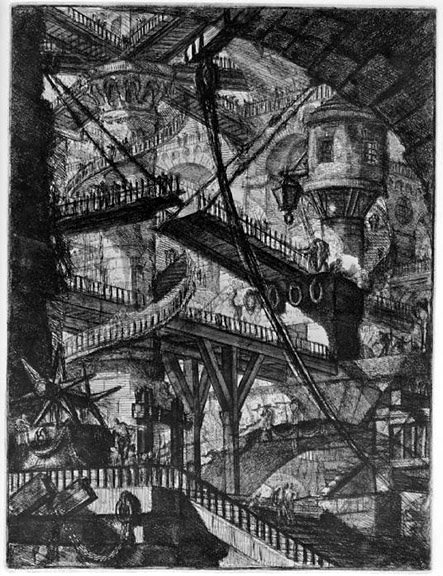
The show starts off with a huge room devoted to the sixteen numbers of 18th century Italian printmaker Giovanni Battista Piranesi's Carceri d'Invenzione ("Fantasy Prisons", or why not, "Fantasy Dungeons"). I'd only seen a few of them before and never at the original large scale. Incredible stuff; kaleidoscopic subterranean vistas peopled by faceless tiny figures scaling endless stairs. Coleridge loved them. Doré copied them. Escher reimagined them as Moebius strips.


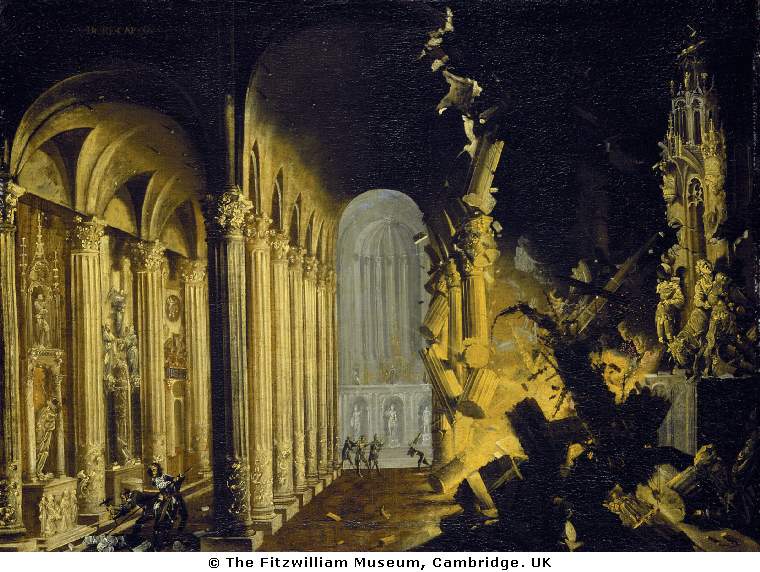
F.D. Nomé. King Asa of Judah destroying the Idols. Fitzwilliam Museum, Cambridge. Not in the Stockholm exhibition.

The next room introduced me to 17th century painter François de Nomé. He too was obsessed with fantasy architecture depicted in dramatic chiaroscuro -- but he preferred to paint it at the moment when it is tumbling down. His paintings may be named "Aeneas flees the burning Troy" or "The Martyrium of St. Catherine", but such mythological matter is only afforded a little corner of each canvas. The rest is devoted to Boschian filigree towers, collapsing arches and burning cities.


In the final two rooms, contemporary painter Ulrik Samuelsson has collected a number of his own canvases together with anonymous works of 15th and 16th century church art. And Samuelsson has taste. The most striking piece is a grotesquely gory and tortured Christ, sculpted at a superhuman scale, originally part of the triumphal crucifix in Sorunda church, Södermanland. This masterful sculpture is extremely stylized and non-naturalistic, to the point where the man's twisted body looks a bit like that of an emaciated horse. Utter madness, and still tightly controlled. Christ as pagan god or tribal idol, wild stuff.

Then there's a life-sized St. Anne from Frötuna church in Uppland, her paint and gilding largely flaked away, but still smiling beatifically. The sculptures are beautifully lit and neither is behind glass: St. Anne you can actually walk around with your nose a hair's breadth from the piece, and study the hollowed back that was never intended to be seen. It's a rare treat indeed to be able to engage so intimately with Medieval wooden sculpture.

"Unsafe Spaces" will be on until 7 January 2007. Prepare to get your mind blown.

[More blog entries about , , , , ; , , , .]

Labels: , , ,

Tuesday, October 17, 2006

Ancient Småland

Another Swedish archaeologist has taken up blogging: check out Pierre Petersson's AHIMKAR! Pierre's approach so far is much more hard-core than mine: every second week he publishes a long essay in Swedish on the archaeology and early history of the Småland coast in southeast Sweden.

Although far from my parts, Pierre's hunting grounds are linked to mine by the ancient sea route from Denmark to the Lake Mälaren area and onward east to Finland and Russia. Load some good stuff on those cogs going north, Pierre!

[More blog entries about , ; , .]

Labels: ,

Monday, October 16, 2006

Clean Hands

The new Swedish government is going through a process of intense journalistic scrutiny, and it's taking its toll: both the Minister for Trade Maria Borelius and the Minister for Culture Cecilia Stegö Chilò have been forced to resign only a week after their appointment. Neither has paid the state broadcasting fees for years, and Stegö Chilò has employed a housekeeper without paying taxes.

Borelius made the mistake of trying to defend herself: "I couldn't afford it". This would have been a silly defense in any case, since we can't have government ministers subscribing to the view that if you want something you can't afford (in this case, access to state TV channels) then you should just steal it. But Borelius is in fact an unusually affluent person, so her words were a big fat slap in the face to the average Joe.

Stegö Chilò didn't make any silly statements, but of course she had to go too. The Minister for Culture is the boss of the state broadcasting company.

Some people think these issues are negligible. But I'm really glad to be living in a country where it matters to a politician's career whether they play by the rules or not. And I'm glad to see the press really doing its job and not just reporting on reality TV.

[More blog entries about , ; , .]

Labels: ,

Wednesday, October 11, 2006

Runes in the Eye of the Beholder


Back in the very early days of this blog I told you about something cool written by my Danish friend Rud Kjems. Now he's done it again: Rud just published an eminently readable book on the history of investigation of the Runamo pseudo-runes.

In the woods outside the town of Ronneby in the southern Swedish province of Blekinge is a flat cliff with a long striated ribbon across it. Irregularities in the surface of this ribbon look almost as if they might be written characters, why not runes? The site was mentioned in writing already by Saxo in the 12th century, who relates that King Valdemar sent his loremasters to Runamo to read the runes, but that they failed. Famous scholars throughout the 17th, 18th and 19th centuries made repeated attempts at making sense of the thing, and some came up with long interesting readings about ancient kings and battles. Until geology and archaeology matured enough to be able to identify the formation as geology.

A long ancient crack in the bedrock has become filled with a crystalline mineral whose natural structure leads to transverse cracks looking like runes. There are in fact other similar features in the vicinity, all built the same way as the ancient quartz quarry I wrote about the other day. The many learned readings at Runamo through the centuries were just moonshine.

I had the pleasure to read Rud's book in manuscript form, and I'm thrilled to see the typography and the many fine illustrations. This is definitely a book to look out for if you're at all interested in Scandinavian archaeology and history.


Kjems, Rud. 2006. Runamo. Skriften der kom og gik. Forlaget Hikuin. Moesgård. 168 pp. ISBN 87-90814-42-8.
[More blog entries about , , , ; , , , .]

Labels: , ,

Monday, October 09, 2006

News From Old Uppsala


Back in January I blogged about exciting new discoveries at Old Uppsala. Today I visited the place and heard talks by a large number of scholars working on issues related to the site, including Magnus Alkarp and Neil Price who identified the foundations of the wooden church as reported here previously.

Here are the most interesting tidbits that I picked up today.
  • Geoarchaeologist and palaeoecologist Magnus Hellquist presented bore core studies of sediments from the little vanished lake of Myrby träsk immediately west of the Royal Barrows. It seems that right about the time when the barrows and the longhouse plateaux were built, there's evidence for enormous localised soil erosion and sediment redeposition in the lake.
  • Alkarp & Price are preparing an on-line gazetteer of interventions into the ground at Old Uppsala, archaeological and otherwise. The model for their project is Martin Carver's work at Sutton Hoo, only they're covering a much larger area. I've done similar work on the Barshalder cemetery on Gotland (covering, among other things, about 45 seasons of fieldwork since 1826). If we're lucky, Alkarp & Price's work may finally lead up to a large-scale excavation campaign at Old Uppsala, the first since the mid-19th century when the Royal Barrows were opened. Dig the mutha, say I!
  • Lars-Inge Larsson showed some jaw-dropping geophysical survey data from the longhouse plateaux. After less than two days in the field, and without lifting a single turf, he's got the as yet unexcavated foundations of the royal halls and later buildings mapped out in great detail. I've got to get this guy to do my ploughland sites in Östergötland before I start digging there.
[More blog entries about , ; , .]

Labels: ,

Friday, October 06, 2006

Quartz Time


Do you know what's in this picture? Click on it to get a bigger version. Check out the details.

Fredrik Molin sent it to me. He's a field archaeologist and Mesolithic scholar working in Östergötland. Together with Magnus Rolöf and other colleagues, he's excavated a Stone Age quartz quarry at Stjärneberg right outside Linköping.

As mentioned here before, quartz is a tricky material to knap, not at all like flint. You get loads of debris, and your actual products are pretty ugly. But it works, and in much of Scandinavia quartz was the number one tool-making material for millennia.

At Stjärneberg Fredrik and the others have documented a small quarry looking pretty much like it did on the last day that somebody used it. The date of use is still uncertain, and the site may have seen repeated visits for centuries or millennia. But there was a knapping floor nearby displaying a bipolar knapping technique particularly common during the Mesolithic, and post-glacial shoreline displacement sets the earliest possible date for the quarry's use to the Late 7th Millennium BC. This is the date that Fredrik suggests: at the time, the site was at the shore of an island with good access to marine resources. Hopefully, radiocarbon from a nearby hearth will settle the issue.


Molin, Fredrik; Rolöf, Magnus & Wikell, Roger. Manuscript. Mesolithic quartz quarrying in Eastern Middle Sweden in the light of a newly excavated quarry at Stjärneberg, Linköping.
[More blog entries about , , , ; , , , , .]

Labels: , ,

eXTReMe Tracker