Antikythera
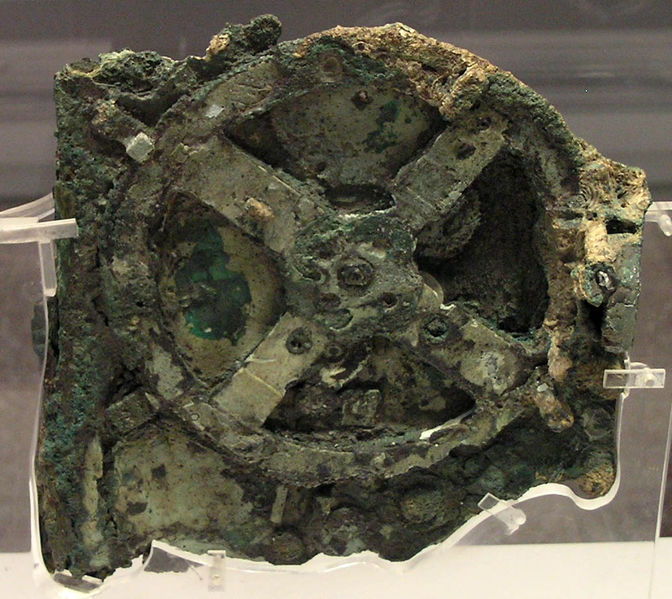
The Antikythera mechanism is an Ancient Greek astronomical simulation device. It sank in the early 1st century BC along with the ship it was travelling on near the island that's given the find its name, and was fished out of the Mediterranean a century ago. A paper in today's issue of Nature presents new work with computer-aided X-ray tomography which has allowed a team of scholars to understand better how the thing worked and to decipher more of its many inscriptions. Using a large number of cogged wheels and gears, the mechanism was designed to simulate and predict the movements and interrelationships of the more important heavenly bodies. Most likely, such contraptions were built among the followers of Hipparchus and Posidonius, whose known interests and level of astronomical insight fit well with the mechanism.
The funny thing about the Antikythera mechanism is that it appears to be isolated, popping up more than 1000 years before the documented start of the High Medieval clockwork tradition. This impression may be due to our incomplete knowledge of what Arabic scholars were doing through the Dark Ages -- they certainly relayed a lot of other Ancient Greek work to posterity. But still, when Medieval Western Europe learned to make clockworks, the technology spread like wildfire, so rapidly that it is impossible to tell exactly where it started. Not so with Antikythera. We have a single find and a few brief mentions of similar tech in the literature of the time. Why is this?
I'd like to submit an idea. The reason that the Ancient Greek clockwork devices didn't catch on may have been that they weren't open source. A proprietary technology, guarded jealously among a small philosophical community, and useless to anyone lacking a solid astronomical education -- it would in fact have been highly surprising if it had started a wave of cultural diffusion. The specimen from the Antikythera wreck wouldn't have been travelling alone: it must have belonged to a philosopher bound for Rome, a man who could maintain the device and use it for astronomical demonstrations and predictions. To anyone else, the mechanism would just have been incomprehensible. And it lay in the best interests of its owner that the world at large remained in the dark about such arcana.
[More blog entries about archaeology, history, astronomy, Greece; arkeologi, historia, astronomi, Grekland.]
Labels: archaeology, astronomy, Greece, history
posted by Martin at 21:02
4 comments


