Monday, November 06, 2006

Book Review: Simak, Visitors

The Visitors
Clifford D. Simak 1980
Original magazine appearance in Analog 1979 in somewhat different form.
Availability: not currently in print, but Amazon has a number of pbs and hbs for sale as low as $.01 -- of course, shipping and handling adds another $3. Alibris has no copy under $2.95 plus s&h.

Reviewed by Jim Benton

Clifford D. Simak wrote science fiction for over fifty years, from 1931 up until his death in 1988, turning out about 30 novels and many short stories. Despite his two Hugos and one International Fantasy Award, I consider most of his work rather minor -- City, a novelization of several short stories, might be an exception, but it has been many years since I have read it. (I have to say that the readers who have voted in Locus polls would differ with me, since Simak finished in the top 30 for best SF author of all time in several of their polls.)

Whatever, certainly The Visitors is one of Simak's weakest works, perhaps his worst and most disappointing. "Disappointing" mostly because it has one major strength. The "visitors" of the title are that rarity, a new idea in aliens, and one worthy of Stanley G. Weinbaum for true alienness. They are building-sized black boxes, most likely creatures rather than ships, that suddenly appear first in orbit around Earth, and then start floating down to land in the rural parts of the US and Canada. They don't speak or communicate with people, but they do respond to them.

A beautiful idea. Unfortunately it is like a giant chocolate shell you are served at a dinner party that you eagerly start to cut, expecting that it is hiding some rich desert; only when you cut into it, you find there is nothing beneath it but air. Yes, the visitors are interesting, especially as they begin to eat trees, and excrete cellulose -- which is contradictory since they are later said to need cellulose for their survival. The people in the book aren't interesting though, neither the minor love interest of the "tree-loving" Jerry and his reporter girlfriend, Kathy, nor the President of the United States and various other politicians. None of them have a third dimension that makes them more than stock characters -- and they're dull stock characters too because there is no conflict, no drama in the entire book.

As hard as it is to imagine, the arrival of the visitors and their exclusively landing in the US causes no "International Incident", no political dispute. The entire world seems to basically be yawning as they wait to see what happens. Well, it is different, if not believable in the slightest, not now, at the time of writing, or any time in the last century.

The point of the book seems to be the way the visitors repay earth for the trees they consume -- oh, I said there was no conflict, but there is a Senator who occasionally wakes up long enough to protest a little, but never with anything more than a speech in a gathering of political figures. There's the obligatory general to say "but they might be dangerous", but he also is turned on, by Simak, for a speech or two, and then put back into the toybox where they all seem to reside.

There is an attempt to compare Earth to the Native Americans, losing their civilization by accepting the white man's gifts, and at one point there is a hint of a really scary potential gift, but Simak doesn't do much with either idea, or much of anything else. If he'd stripped the book of ninety percent of its words, and written a short story using the one idea I mentioned, it might have been a major work. If his mention of it on page 220 and then suggesting it again on the last page had been surrounded by anything believable, it might have rescued the book. But by the time you get it, you've stopped thinking, out of self-preservation. Stopped thinking, or caring.

[More blog entries about , , , , ; , , , , .]

Labels: , ,

Sunday, October 15, 2006

Science Fiction Fanzine


Blogging is nothing new. It's been going on at least since the 1860s when the amateur press movement started. H.P. Lovecraft's writing career, for instance, took off in 1914 thanks to this little world of home-made magazines. Since World War 2 they've been called fanzines, and they've been integral to the science fiction and alternative music subcultures. Now they've largely transcended their paper substrate and entered the realm of immediate low-cost digital availability. Fanzines are on the net. The amateur press movement has exploded into the blogosphere.

Paradoxically, one of the few groups that still produce paper fanzines is science fiction fandom. In this day and age, these avant-garde champions of futurity still cherish the mimeograph and the Xerox machine, still hate the Post Office, still keep paper mailing lists. It's part of their subcultural identity. But a lot of the material in the paper zines also appears on-line.

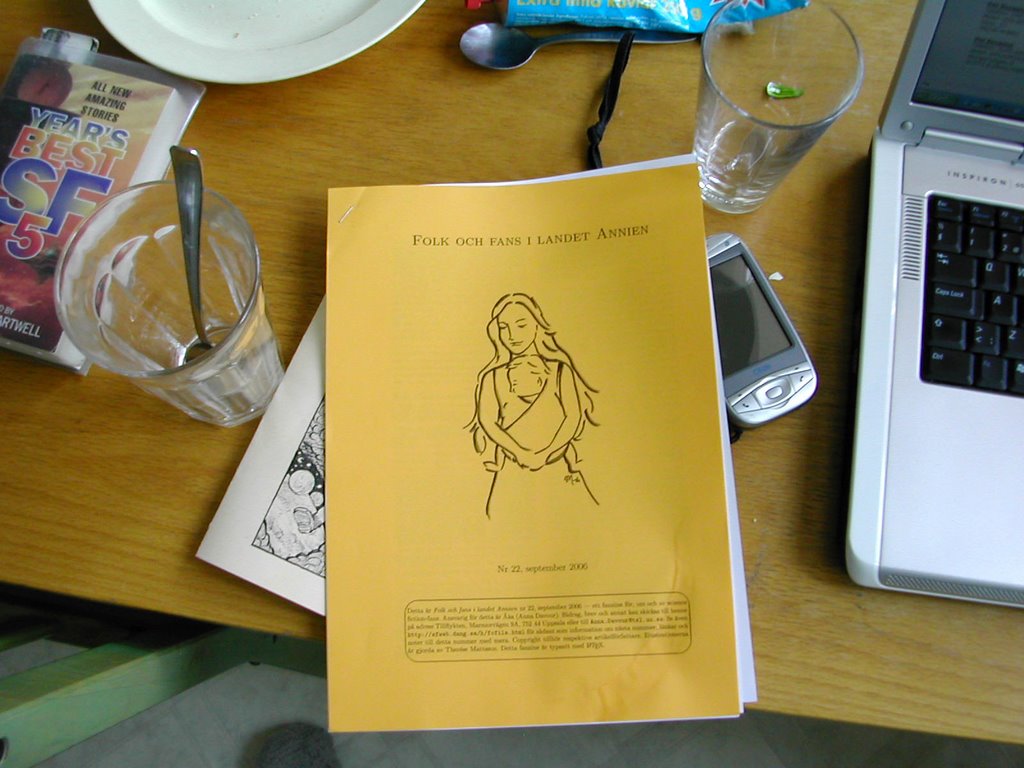
Yesterday I was given one of these increasingly rare cultural artefacts by the kind and charming Anna Davour. It's the expanded paper incarnation of her blog and contains a lot of interesting stuff, including book reviews and discussion of the relationship between fanzines and blogs. I particularly liked Anna's piece on baby carrying shawl fandom.

Shawls are more Bronze Age than futurism, but Swedish sf fanzines have had a nebulous relationship to actual sf for decades. They're the lifeblood of a subculture more than commentary on a literary genre.

[More blog entries about , , ; , , .]

Labels:

Thursday, October 12, 2006

Fifty Years Out Toward Lyra

The Swedish language has produced very few really good works of science fiction. (Give us a break, Swedish has less than nine million native speakers). One of these few really good works was published 50 years ago, and the occasion was celebrated with a symposium today at the Academy of Letters. It might have been the Swedish Academy, because the book's author was a member and they awarded him the Nobel for it. I'm talking about Harry Martinson's science fiction verse epic Aniara.

The Aniara is an interplanetary spaceship full of colonists bound for Mars, escaping from an Earth ruined by pollution and nuclear fallout. On its way from Earth the spaceship evades an asteroid, gets thrown off course, sustains heavy damage to its steering, and ends up randomly on a course for Lyra. The constellation's stars are so far away that when the Aniara finally arrives there its passengers will have been dead for aeons. In 103 cantos of varying length and lyrical form, Martinson tells stories of the people on board as they progress through the years on their pointless journey into interstellar space.
We came from Earth, from Dorisland,
the jewel in our solar system,
the only orb where life obtained
a land of milk and honey.
Describe the landscapes we found there,
the days their dawn could breed.
Describe the creature fine and fair
who sewed the shrouds for his own seed
till God and Satan hand in hand
through a deranged and poisoned land
took flight uphill and down
from man: a king with ashen crown.

Aniara, canto 79, by Harry Martinson.
Translated by Stephen Klass and Leif Sjöberg 1999.
The book is very much a product of the Cold War: marked by concerns about environmental degradation and the nuclear threat. It is also a pessimistic book, a vision of the futility of human endeavour, very far in tone from what for example Robert Heinlein was writing at the time. But Aniara draws from the same background of sf tropes as Heinlein's books, offering an alternative and cautionary take on what is sometimes called Golden Age sf.

As a child, I used to feel a deep stomach-churning horror at the thought of that crippled spaceship falling away into the darkness. Looking at it now, I'm not so sure the alternatives would have been much better. The people on the Aniara fled a dying Earth to live as colonists on inhospitable Mars. Neither their origins nor their intended destination was Paradise, and so their fall into darkness shouldn't really be seen as a fall from grace. They have food and power to last them for years. They continue to produce cultural fads, religions, even scientific discoveries. Sure, they're all fucked. But they were fucked before they even went aboard the Aniara. And that, I guess, is how the gloomy yet brilliant poet, then just into his 50s, saw life. We're fucked. Nobody gets out of here alive.

*
Harry Martinson wasn't a glumster all of his life. For youthful vigor, optimism and prose-lyrical mastery, read his early books about life as a sailor in the merchant navy: Resor utan mål (1932) and Kap Farväl (1933).

[More blog entries about , , , , , , ; , , , , , .]

Labels: ,

eXTReMe Tracker