Sunday, November 05, 2006

Jim Benton on Fundies vs. Gay Marriage


Why Radical Christians Hate Gay Marriage
By Jim Benton

Openly, the Radical Religious opposition to gay marriage usually makes two arguments.

(The "gays are sinners and are going to hell, and should be prosecuted if the damn Supreme Court hadn't allowed sodomy" claim doesn't get made that much in public. Even red-state America has become accepting enough of gays and lesbians, and opposed to blatant discrimination, that this stance wouldn't sell among the electorate as a whole. But they know the bigots and gay bashers -- especially the ones who take the phrase literally -- will be on their side anyway, they don't have to appeal to them directly.)

The appeal to tradition
They usually start off with the argument to tradition. "Marriage has always been between one man and one woman." With its appeal to a mythical past -- for most people "always" means "in their lifetime and their parents' and grandparents" -- this gets them a certain percentage of the votes.

But let's face it, it is a weak argument if you are trying to scare people onto your side -- and the appeal is to fear, don't get that wrong. Even if the statement were true, even if the idea of marriage hadn't changed throughout time (and certainly the ‘indissolubility of marriage' that is, in fact, Biblical, has changed, to the point that a surprising number of gay marriage opponents are on their second or third marriage) traditions are for those who celebrate them. "Thanksgiving dinner has always included turkey." Well yes, and that is a celebration that I gladly celebrate. But if my neighbor chooses to serve ham or chicken or steak or is a strict vegetarian and serves lasagna, that doesn't make my turkey any less meaningful or tasty to me. In fact, it doesn't affect me unless somebody invites me to a Thanksgiving dinner and serves me chicken, as my mother-in-law once did. Grrrr. (I think I went out after dinner and bought a small turkey platter from a restaurant. This is one celebration I am very devout about.)

But the fact of the matter is that the idea of "marriage means one man and one woman" just ain't so. And when I say this, I am not talking about anthropological evidence from societies throughout the world. Christians would, with a certain amount of justice, argue that it's irrelevant how a society of heathens conduct their life. They are only interested in the Judeo-Christian heritage they so proudly follow.

Unfortunately, that heritage doesn't bear them out. Early Judaism was polygamous, polygynous in fact. And the Christian claim that this was a "special exemption granted to the Patriarchs" is just plain wrong.
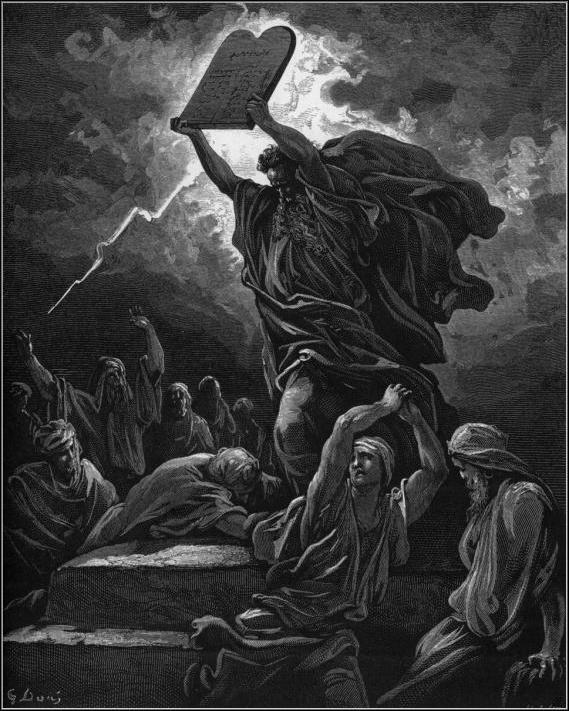
"How do we know? The Bible tells us so." At least Leviticus does. The commandments of Leviticus were written for the whole of society, not the patriarchs. If you read the whole of Leviticus 18 -- yes, the very same chapter that condemns male-male anal sex (I know of no verse in the Bible that mentions oral sex of any type) -- you'll find several passages that only make sense in a polygamous society.

The obvious examples start with Leviticus 18:7-9:
7 Do not dishonor your father by having sexual relations with your mother. She is your mother; do not have relations with her.

8 Do not have sexual relations with your father's wife; that would dishonor your father.

9 Do not have sexual relations with your sister, either your father's daughter or your mother's daughter, whether she was born in the same home or elsewhere."
I could go on to quote other verses, but these are enough to show the distinctions that are made between "your mother" and "your father's wife". your sister who is "your father's daughter" and your sister who is "your mother's daughter". Such distinctions only make sense in a polygamous society.

Was this just a dispensation for the times? No. Jewish society remained polygamous at least up until the time of Jesus. Perhaps not in the rural, poor parts of Galilee where Jesus lived. But let us look at what Flavius Josephus has to say. The great general and historian was born into the highest priestly class of Jerusalem, as he proudly relates in his Autobiography. He was almost contemporaneous with Jesus, in fact, he was born within a couple of years of the traditional date of Jesus' death. In the same Autobiography he tells us:
"I was myself brought up with my brother, whose name was Matthias, for he was my own brother, by both father and mother..."
Again, this is a distinction made unnecessary except in a polygamous society. But did Jesus condemn the practice? (He did condemn divorce, but the Old Testament has many condemnations of divorce. In fact, there are several places where a man is told that, because of a crime, such as falsely accusing his wife of not being a virgin, he must remain married to her, yet he is not prohibited from having other wives.) He is not shown to, but then there must have been many preachings of his that did not get recorded in the Gospels. If he did condemn having multiple wives, the writer of the Epistles to Timothy and Titus and the early Church do not seem to have been aware of it. (I'll use the KJV. The New International is better, but a lot of Christians act like they believe "if the King James was good enough for St. Paul, it's good enough for me." And in fact, the statements are stronger in it.)
1 Timothy 3:2. A bishop then must be blameless, the husband of one wife,

1 Timothy 3:12. Let the deacons be the husbands of one wife, ruling their children and their own houses well.

Titus 1:5-7. 5 For this cause left I thee in Crete, that thou shouldest set in order the things that are wanting, and ordain elders in every city, as I had appointed thee:

6 If any be blameless, the husband of one wife, having faithful children not accused of riot or unruly.

7 For a bishop must be blameless, as the steward of God; not selfwilled, not soon angry, not given to wine, no striker, not given to filthy lucre;
But: if these are specific requirements for a bishop or deacon, they can't be the requirements for the people as a whole. They may be considered advisable. Polygamy might be blameworthy, but it is not forbidden. (Thus being self-willed or given to wine are flaws, not forbidden. Imagine if the passage read must not be a murderer and you can see the absurdity.)

Even if this was all that was meant by "traditional marriage", it seems hard to understand how expanding it to include same-sex marriage would be at all threatening to it. This point has been made time and again, both by gays (Barney Frank's question to Bob Barr, "Which of your three marriages is threatened by mine?) and heterosexual couples who deny any feeling of threat from the acceptance of gay marriage.

Marriage as defined by female submission
But, I would argue that while many of the people who make the statement about marriage being threatened are just parroting what they have heard, the Radical Christian opponents actually mean something different when they talk of "traditional marriage". And they are quite right in their argument. Gay marriage is a threat to their conception of what marriage should be.

A "good, Christian marriage" is not just one involving one man and one woman. It involves a specific relationship between them. A wife is supposed to be subject to the husband, and the children to the parents, as humanity is subject to God.

To quote Focus on the Family's What Does It Mean to Be a Wife by Mitch Temple:
The apostle Paul urged older women to teach younger women, "so that they will wisely train the young women to be sane and sober-minded -- temperate, disciplined -- and to love their husbands and their children; to be self-controlled, chaste, homemakers, good-natured (kindhearted), adapting and subordinating themselves to their husbands, that the word of God may not be exposed to reproach — blasphemed or discredited."
Again from FotF (How a Husband Should Handle His Wife's Submission by Stormie Omartian):
"Submission is a choice we make. It's something each one of us must decide to do. And this decision happens first in the heart. If we don't decide in our hearts that we are going to willingly submit to whomever it is we need to be submitted to, then we are not truly submitting."

"This may be shocking news to you, but an overwhelming majority of wives in my survey said they want to submit to their husbands. They want their husbands to be the head of the home, and they have no desire to usurp that God-given position of leadership. They know what the Bible says on the subject, and discerning wives want to do what God wants because they understand that God's ways work best."

"Okay, okay! I know that God did not say a wife needs to submit to her husband only if he proves to be worthy. Submission is a matter of trusting in God more than trusting in man. But a wife will more easily make the choice to submit to her husband if she knows that he has made the choice to submit to the Lord. It will be a sign to her that it is safe to submit to him."
For a similar view let's look at the Southern Baptists. In an article on subjugation of women in that denomination, Dr. Bruce Prescott & Dr. Rick McClatchy (who have become "Mainstream Baptists", a group which split from the Southern Baptists as a protest against the emergence of extreme and rigid conservatism in the older group) write in Baptist Faith and Message, a Baptist "Confession of faith"):
"subjugation of women extended to the privacy of Baptist homes when a statement on the family was added to the BF&M. In line with the chain of command made explicit in the 1984 resolution, the 1998 family amendment advised wives that they must ‘graciously submit' to their husbands."

"The unconditional nature of the wife's subjugation became clear at the official press conference following the statement's adoption. Dorothy Patterson, wife of Paige Patterson and a member of the committee that drafted the family statement, said, ‘When it comes to submitting to my husband even when he is wrong, I just do it. He is accountable to God.'"
But these groups are relatively liberal. I could go on and on -- oh, you've noticed -- but I'll end this by requoting Tedd Tripp, from my article on baby beating.
"You must provide examples of submission for your children. Dads can do this through biblical authority over their wives, and Moms through biblical submission to their husbands." p. 142

"Don't waste time trying to sugarcoat submission to make it palatable. Obeying when you see the sense in it is not submission; it is agreement. Submission necessarily means doing what you do not wish to do. It is never easy or painless." p. 145

"Your children [and by implication, your wife] must understand that when you speak for the first time, you have spoken for the last time." p. 151
But what has all this to do with gay marriage? After all, many, hopefully most marriages outside of the stricter religious groupings would reject these teachings, would look on horror at this sort of authoritarian marriage. (In fact, many people who saw their parents in such a relationship have recoiled in horror at it and made sure they would not experience what they saw their parents, particularly their mothers, undergo.) And there is no doubt that gay relationships can be dominant/submissive themselves.

This is true, but a heterosexual marriage that deviates from "God's plan" can be condemned as such, and there is always hope that through "good Christian example" teaching, preaching, and prayer, these "misguided sinners" can be shown the proper path. (And the true dominionists can hope they will have the power of the state at least to teach students properly, and even have laws that will correct the poor, deluded "equalitarians".)

But there is no way that a gay couple can choose to conform to these teachings. The roles, in the minds of the radical Christians are biologically and theologically based. The question of which gender should be submissive is not a matter of choice. It is rooted in the idea that "man was created first and woman sinned first" in Eden. Yes, a woman may (and should, according to voices like Stormy Omartian's) freely choose to submit to her husband and act according to God's plan. But that is because she is a woman. A man who should choose to submit to his wife, in the same way, would be an unnatural abomination.

And, obviously, same-sex marriages either do not have a woman to "willingly submit to whomever it is we need to be submitted to", or they lack a man to be submitted to. No amount of preaching can change this, no amount of Christian example will change this. Any gay marriage, by existing, challenges this idea of a proper, "traditional" marriage.

Even if one man in a gay marriage chooses the role of homemaker, of the guided one, the "wife", this is not sufficient, since he is going against his masculine nature. (And of course, the corresponding can be said for lesbians, like the two women who were my parents. They have no one to express their femininity to by submitting, and again, if one is dominant, this is condemned as well by the fundies' god and Bible.)

It is a constant threat. No wonder radical Christians are horrified and must fight it. In their way of conceptualising things, gay marriage simply cannot be. And so it must not be. It's basically an issue of road-map versus terrain.

[More blog entries about , , , ; , , , .]

Labels: , ,

Sunday, October 01, 2006

Jim Benton on Christian Child Abuse Manuals

Here's a chilling piece by Jim Benton on Christian fundamentalist child-abuse manuals. Sweden outlawed all forms of physical discipline in child rearing in 1979.
Bible Based Baby Beating
By Jim Benton


Warning: the following will be and should be disturbing to many of you, particularly parents. If you are squeamish, or think that children are individuals to be loved rather than creatures whose main job is to obey mindlessly, you might want to avoid this. But you may be the ones who most need reading it. And I can't avoid saying that any of you who are involved in an American political election where one candidate is supported by the Religious Right and Focus on the Family in particular, should challenge this candidate to say whether he accepts practices and attitudes like these.

Two preliminary notes:

1. I can't take credit for the research on this, which is mostly based on the work of Dogemperor on the Talk2Action and websites, and the conservative Christian home-schooling mothers of Stop the Rod who grew sick of the advice they were getting about raising their children.

2. I refer to the authors and their ideas as "Christian" because it is the term they use and they claim to have biblical backing. However, I have no doubt that most Christians, no matter how conservative, would be as disgusted at this matter as any other reader. Maybe more so because it is their religion that is being slandered.

People who discuss Focus On The Family and similar groups tend to look at what such groups are against: gays, abortion, contraception, pornography, sex in general. But there hasn't been enough attention to the sort of things such groups are for. What sort of families do they focus on? What do they think about how children should be raised?

Thanks to the writers mentioned above, I've started focusing on these Christian Right families themselves, or their ideas on child-rearing.

Let's start with James Dobson himself. The quotations below are from his 1992 book The New Dare To Discipline, quoted by Dogemperor, himself a survivor of Christian child abuse, and Stop the Rod. When I use the term "child abuse" here I am referring to physical, not sexual abuse. Of course, as with any quotations, readers should check their accuracy. But having checked Dobson's web sites, I see no reason to doubt Dogemperor.

"My primary purpose ... has been to record for posterity my understanding of the Judeo-Christian concept of parenting that has guided millions of mothers and fathers for centuries." p. 18

Dobson advises to hit a child for "willful, haughty disobedience" and when a child says "I will not!", Dobson advises to "respond to the challenge immediately." Challenging authority and "disrespect" deserves corporal punishment. p. 20

Dobson turns parenting into a contest of wills: "You have drawn a line in the dirt, and the child has deliberately flopped his bony little toe across it. Who is going to win? Who has the most courage? Who is in charge here? If you do not conclusively answer these questions for your strong-willed children, they will precipitate other battles designed to ask them again and again." p. 21

Dobson says parents must not "yield authority to their infants." "A child's resistant behavior always contains a message to his parents, which they must decode before responding. That message is often phrased in the form of a question: ‘Are you in charge or am I?' A distinct reply is appropriate to discourage future attempts to overthrow constituted government in the home." p. 29

Dobson claims that "Nothing brings a parent and child closer together than for the mother or father to win decisively after being defiantly challenged." p. 34

Are we talking about unruly teenagers here? No, as we see with the last series of Dobson quotations (comments mine):

Dobson describes a mother shaking her 3-year-old for spitting. The child spat again. This was "embarrassing" to the mother; she was "too weak or tired or busy to win." (Three years may be too old for shaken baby syndrome. Maybe.) p. 28

Dobson says "spanking should be of sufficient magnitude to cause genuine tears." p. 35

Dobson's wife whipped their 15 month old daughter for going onto the patio in the rain. Dobson says to show "parental warmth after such discipline" and to have a "loving conclusion to the disciplinary encounter." p. 36

Dobson recommends painful squeezing of the trapezius muscle on the neck to obtain "instant obedience." p. 36

Dobson says "sick and deformed" children can be hit too. p. 57

Dobson recommends using switches and paddles to hit children. p. 64

Dobson recommends starting whipping at age 15-18 months, and "there is no magical time at the end of childhood when spanking becomes ineffective." p. 65

Dobson recommends hitting a toddler when he "defies his parents' spoken commands". He advises to hit toddlers when they have tantrums, and when a toddler "hits his friends". Toddlers should be "taught to obey." Toddlers can be given a "firm rap on the fingers." p. 66

Spank children if their bedwetting is an "act of defiance." p. 68

If a child cries more than a few minutes after being spanked, hit them some more. p. 70

If spanking a child doesn't produce obedience, a parent needs to "outlast him and win, even if it takes a few rounds." Parents must always punish "acts of defiance." p. 71

Spanking should not be "too gentle." p. 72

"With most children, tantrums are a form of challenging behavior that can be eliminated by one or more appropriate spankings." p. 108

But Dobson is in fact a fairly mild advocate of Christian child abuse. Let's just take a quick look at some other quotations from supposedly scripture-based child rearing manuals.

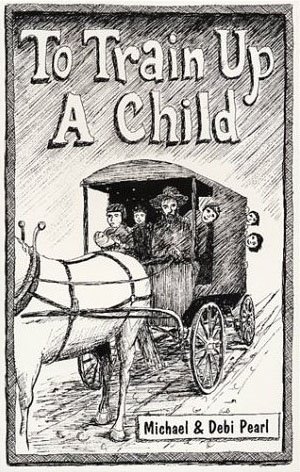
To Train Up a Child by Michael and Debi Pearl (1994; I have this downloaded and will give more quotations in the future. These are my own selections and have no page numbers because the original does not.)

"One father tells of his training sessions with each new toddler. He sets aside an evening for ‘booty' camp, which is a boot camp for toddlers. The child of ten to twelve months is left alone to become deeply interested in a toy or some delightful object. From across the room or just inside the other room, the father calls the child. If he ignores the call, the father goes to him and explains the necessity of immediately coming when called, and then leads him to the father's chair. The child thus led through these paces is being programmed.

He is returned to the toy and left alone long enough to again become engrossed. Another call, and, if no response, the father gives a patient explanation and demonstration of the desired response. The parent, having assured himself of the child's understanding, once again sets up the situation and calls the child. This time, if there is not an immediate response the child is lightly spanked and lectured. The father continues this throughout the evening until the child readily and immediately responds to a summons. Thereafter, until the child leaves home, he is expected to drop everything and come upon the first call. As long as the parents remain consistent, the child will consistently obey. This "obedience training" is carried out in the utmost patience and concentration. The spanking should not be viewed as punishment, but as reinforcement to commands."

"The parents who put off training until the child is old enough to discuss issues or receive explanations find their child a terror long before he understands the meaning of the word. A newborn soon needs training. The child needs holding, loving and lots of attention, but the mother often has other duties.

As the mother, holding her child, leans over the crib and begins the swing downward, the infant stiffens, takes a deep breath and bellows. The battle for control has begun in earnest. Someone is going to be conditioned. Either the tender-hearted mother will cave in to this self-centered demand (thus training the child to get his way by crying) or the infant is allowed to cry (learning that crying is counterproductive)."

"Clearly, the lines were drawn. The battle was in array. Someone was going to submit his will and learn his lesson. Either the father would confirm that this one-year-old could rule his parents or the parents would confirm their authority. Everyone's happiness was at stake, as well as the soul of the child. The father was wise enough to know this was a test of authority. This episode had crossed over from ‘obedience training' to discipline for attitude."

"We have progressed to the place where a discussion of the use of the rod is in order. Let's talk about spankings -- sometimes called ‘whippings'. ‘He that spareth his rod hateth his son: but he that loveth him chasteneth him betimes (Prov. 13:24).' This seems to go exactly opposite to the feelings of many parents and educators. The passage clearly states that a failure to apply the rod is due to the parents' hating the child. ‘No!' cries the mother, ‘I love my child too much to spank him.' The parent who responds thus does not understand: 1) the authority of God's word, 2) the nature of love, 3) his (or her) own feelings, 4) the character of God, or, 5) the needs of the child."

"The guilt burdened soul cries out for the lashes and nails of justice. Your child cannot yet understand that the Creator has been lashed and nailed in his place. Only the rod of correction can preserve his soul until the day of moral dawning. That is why the soul of man never rests until the conscience has been pacified by a believing look at the bleeding, crucified, substitute of the Lamb of God."

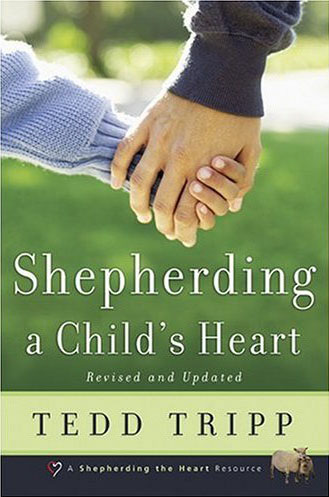
Shepherding a Child's Heart, audiobook by Ted Tripp (1995; from Stop the Rod).

"You need to direct not simply the behavior of your children, but the attitudes of their hearts. You need to show them not just the ‘what' of their sin and failure, but the ‘why.'" p. xx

"You want to control the flow of events so that it is never chaotic, but rather a well-structured home." "I am interested in helping parents engage in hand-to-hand combat on the world's smallest battlefield, the child's heart." p. 23

From birth to age 4, "The most important lesson for the child to learn in this period is that HE IS AN INDIVIDUAL UNDER AUTHORITY." p. 133

"Acquaint your children with authority and submission when they are infants. This training starts the day you bring them home from the hospital." p. 134

"It is imperative that children learn to honor and obey. The disobedient child has moved outside the place of covenant blessing." p. 135

"Obedience means more than a child doing what he is told. It means doing what he is told --
Without Challenge
Without Excuse,
Without Delay." p. 138

"When your directives are met by a discourse about why what you have asked is not fair, your children are not obeying. When you are met with excuses or explanations, they are not obeying. When they refuse to respond at once, they are not obeying. When you say to your child, ‘Dear, I want you to go to bed now', there is only one appropriate response. It is not, 'I'll go after I finish coloring this page.' There is only one obedient response. It is to go to bed without delay. If you accept any other response, you are training your children to disobey. You must challenge disobedience and persevere until the lessons of submission are learned. Victory does not come to the faint of heart. Never allow your children to disobey without dealing with them." p. 139

"You must provide examples of submission for your children. Dads can do this through biblical authority over their wives, and Moms through biblical submission to their husbands." p. 142

"Don't waste time trying to sugarcoat submission to make it palatable. Obeying when you see the sense in it is not submission; it is agreement. Submission necessarily means doing what you do not wish to do. It is never easy or painless." p. 145

"Your children must understand that when you speak for the first time, you have spoken for the last time." p. 151

A parent poses the question "What if my child says, ‘But I didn't hear you?'". And Tripp's answer is "One of our children seemed to have much trouble with ‘hearing.' We sat down with this child and had this conversation: ‘You are having trouble hearing. I think, therefore, that you better start to develop the ability to pick my voice out of the other noise in your world. When you hear my voice, you should perk up your ears. From now on, if you fail to obey because you ‘did not hear', I will spank you for failing to listen to my voice.' We only had one spanking for failure to hear. After that the hearing problem cleared up." p. 155

What the Bible Says About ... Child Training (ellipsis in title) by J. Richard Fugate and Richard Fugate (1999; Stop the Rod has scanned the whole of Chapter 17, "The Correct Use of Chastisement" onto its website. I can only quote and abstract ideas.)

A few quick quotes and abstractions (note that "chastisement specifically and always involves causing pain", and ideally marks that will "of course" fade rapidly:

The use of chastisement is revealed (quoting a long series of verses from "Proverbs") as a necessary factor in the child's being trained toward wisdom and away from foolishness.

Mothers should use the rod as well. It may go against her instincts, and "uninformed mothers may even try to interfere with the father's proper use of the rod." But she must learn to become a "godly mother" and learn that chastisement is necessary for the long-term benefit of her child.

The child's rebellion against parental authority is what is being punished, and the child may choose to end the pain simply by submitting. "He should be given the opportunity for an honorable but unconditional surrender."

It doesn't break a child's will or spirit to force him to obey, it just makes him choose obedience over rebellion.

Chastisement is not merely humane, it is Divine. Would it be less humane for the child not to learn the proper attitude towards authority and become a "criminal, a drug addict, or a homosexual"?

Let's end with a discussion of suitable size rods to use on children of different ages -- because the hands of a parent should 'symbolize protection, comfort, and beckoning' the Fugates say, apparently without irony. They oppose spanking, preferring to use rods of various sizes. The Fugates maintain that when a rod is used by a parent, the child does not focus on the person using the rod but the rod itself. A child should be, if necessary -- which it shouldn't be since he should be already trained to obedience by eight to twelve -- chastized up until the age of twenty.
  • From the time the toddler begins to crawl until about 15 months ("age is no real criteria [sic] -- how large and how stubborn the child is will be the real issue") use a blackboard pointer, a balloon rod, or an eighth-inch dowel rod.
  • Age 1-2 a "tot rod" -- 3/16" by 24" dowel
  • 2-4 "mob control' -- 1/4" by 24"
  • 4-8 "train or consequences" -- 5/16" by 27"
  • 8-12 "the equalizer" -- 3/8" by 27"
  • 12+ "the rebel router" -- 1/2" by 33"
(The last is the length of, and one third the thickness of, an average major league baseball bat.)

A few final quotes from the Fugates, courtesy of Stop the Rod.

It is un-Christian for a child to "seek attention, food or drink" or to play. p. 12

"Parents do not owe their child an explanation for their instructions. If you think it is necessary to explain your reasons, do so only after he has obeyed. … a clever child who is allowed to question his parents' instructions can confuse the issue and thereby avoid obedience. He may even turn your own words back on you: ‘But you said…' While it is true that you will make some mistakes with the use of your authority, it is not your child's responsibility or privilege to correct you." p. 94

Children "should be expected to follow the commands of their parents to the letter." p. 103

Emphasize "forced compliance" in children. p. 105

Starting at birth, "parents will decide when he should eat, sleep, and play" p. 108

"Women have to be taught when to withhold their natural love for their children." p. 124

"Adult sons who have been over-protected … may even become homosexuals. Biblical child training principles can be self-applied by any adult who identifies himself with this type of upbringing." p. 125

"A wriggling six-month-old baby who intentionally refuses to be diapered can be taught the meaning of "no" in one or two simple lessons. When he tries to crawl away during a changing, he can be told "no," pulled back, and held in place for a moment. The next time he tries to crawl away, he should be told "no" once firmly and lightly tapped once or twice on the upper leg with a small switch. The shocked look and tears will indicate you got his attention and that the command "no" has taken on a real meaning. An angry cry and continued squirming may indicate a strong-willed child who will require more pressure in both intensity and frequency." p. 127

"Never give in to a child who is begging for something he wants. … When a child consistently and instantly obeys his parents on command, he has learned the most important standard." p. 130

I will get back to this topic. There are many other relevant writers I have not mentioned.
[More blog entries about , , , ; , , , .]

Labels: , ,

eXTReMe Tracker